Friday, 16 November 2012

Pyramids

Lately I have been studying researching ancient Pyramids in Egypt, like many others I have been fascinated with their impressive scale, their hidden meanings the geometry behing them but I am also also looking at how the image of the pyramid is  been used now days in a completly different context by varied artists. I am doing this as in the future I would like to work on a conceptual piece based on the  image of the pyramid but I am also interested in the social meaning more to do with Capitalism that has come up in some Contemporary American artists to challenge the notion of Capitalism as it stands at the moment & their version of producing something alternative to Capitalism: a more equal social structure.
Officially Ancient Pyramids where tombs of the Pharaos and their Queens. But the variety of symbols, their positions made people study & discover other meanings. Some people say they are symbolic of a mountain, that the square base actually rappresents the four corners of the world and four directions and that the peak connects the sky to the earth basically it is a path between the wordly and the heavenly so they where houses of eternity but it also rappresented social class. The social structure was based on power. The Paraoh was at the top with officials then priests then scribes last where the peasants. If One compares this with the contemporary artwork, performance by occupy LA with Robby Herbst where they mirror contemporary class dynamics inspired by a 1911 diagram by industrial workers of the World called Pyramid of the Capitalism system.Robby Herbst & Occupy LA work seems to be about how we act or how we move our bodies to shape the pyramid or reshape and doing so how we shape and reshape our society, our place in the pyramid or how he said it: how we construct and enact the pyramidal form. Or by his other work stacked chairs which I find really freeing, from the obsolate strict hierachy structure of Capitalism which is based on money and power, as anybody can sit on the chairs at any given time


 I am also interested in the Maslow hiererchy of needs, by the American Psychologist Abraham Maslow, which is potrayed in the shape of the pyramid where he says phychological needs have priority over other needs and they should be met first  where self actualization is most important and especially by the fact that he says that without a balance between physical, financial, health, wellbeing, safety maybe  due to war, family violence, abuse people or economic crisis as we are experiencing at the moment a lot of people are at a disadvantage and experience post traumatic stress. So what interest me is not only the physical rappresentation of the pyramid but also the psycholgical, emotional side which in a capitalistic society is taken aside behind producing and consuming. 
There is also the work of David Huffman: Basketball Pyramid  at SF Arts Commission Gallery where he looks at race trought the use of the basketballs, a popular object known to almost any American. Then there is the work of Beau Blinky which is completly different it's more sculputural in a more traditional way on the right hand side he is interested in outdoor sculptures more then indoor conceptual work so another different function of the pyramid.

and then there the minimalist Isometric paintings Pyramid of Sol Let Witt which are directly painted onto a wall as other minimalist artists he was interested in the idea not to show that the artist had created the painting so he left just instructions on how to paint it for others to do it.
 Sample of other art works rappresenting pyramids made from scraps or Lego


Or the human body as the pyramid through it's chakra centres as it's known in new age circles. I have been looking at the different forms and meanings of the pyramid for my own conceptual work I am interested in the actual physical structure, the geometry but also by the different concepts that have been used by contemporary artists that have used the image of the pyramid combined with concepts to open a discussion about Capitalism and our role in society.  


Saturday, 10 November 2012

Alan Cristea Gallery: Edmund de Waal


I was crisscrossing around Bond Street when I pass by the Alan Cristea Gallery a commercial art gallery in
Cork Street  when the exhibition inside got my attention.The artist on show is Edmund de Wall.


The title of the exhibition is a Thousand Hours an installation of black and white cases open and closed of a rectangular size in one room and in the other room another closed case of a large scale that one can walk  move around giving it more of an architectural feel. Inside of the cases one can see long  tubular ceramics or flat ceramics of a similar shape and of similar colour positioned closely together in the case of the tubular ceramics or one on top of the other in the case of the flat ceramics both are made out of porcelain. The colours of the pots work together with the outside colours of the cases, they give out to the viewer a sense of harmony combined with the rectangular precision of the shape of the cases which make one think more of carefully designed objects of an architectural nature viewed in public spaces then pottery based in a house. Also  the pots are individually made by the artist and have a natural imprecise feel to them which  are counteracted by the precision of the shape of the cases which give out the idea that the artist wants to hold the vessels somehow in space not to frame them but to be wanting them to hold them in their movement this is allowed by the fact that the viewer can walk around or through the cases and feels surrounded by the vitrine pots from below and above . Some are easy to see while other are hidden behind the opaque glass of the cases, so they are out of reach. Edumund de Wall said that he liked 'to record the thousand hours of tiredness, exhilaration (spent while making the work): my sense of the fleeting moment and its afterlife'.
The works I have seen at the Gallery where: Weights & Measures,2011:small stacked ceramic dishes apparently it was inspired by the work of Richard Serra Weight and Measure which was exhibited in the Halls of Tate Britain in 1992.


Poetry also features in Edmund de Wall work in pieces such as a Lament 2012, Three Poems of Return 2012 and in The Pleidaes Hide Away,2012
The first one is based on Giotto's 'Lamentation' this can be seen by the fact that the work is been installed up high to give a feeling of release similar to the Angels in Giotto's Lamentation where they are seen above the scene of mourning of the Christ.


 In the second one the ideas is based on Sappho's Fragment 44 written in response to the Iliad. I also did  notice that he doesn't use the whole text of a poem but just fragments of it. The third art work is based on the ancient Greek poet Hesiod (c.750-650BC)and his work the Atronomy where he wrote about constellations, stars  and on the Pleiades the  mythological daughters on Atlas which where considered by Greek astronomers as distinct constellations. All of this is represented using 'stopped' shelves to signify the fragments of Hesiod's text of the constellations combined with the black glazes of the actual pieces to evoke the essence of the galaxies at night.
One other important reference to the specific piece of In Praise of Shadows, 2012 is the essay by Ju'ichiro Tanizaki on Japanese aesthetics where it's discussed the importance of light and dark and how some things should be left in the shadows and others should be brought to light. All of this made me think that Japanese aesthetics as had a strong influence on his work and the way he works and displays his art work. Over all he is been able to successfully join traditional methods of work with contemporary more conceptual  so to join east and west.With this exhibition is been able to bring into a contemporary conceptual setting pottery so to reach a wider and different audience is been able to combined traditional methods with modern methods the fine artists with the potter.

This exhibition made me rethink at the way I display my own ceramics generally I have shown my ceramics on pillars but with my current sculptural work that I have been recently making I want to experiment and place them on shelves on a wall to see what effect this has on the viewer. My ceramics are very different from Edmund de Wall works as his work the vessels seem to be mainly pottery done on a wheel. My ceramics are not done using a pottery wheel. As I see the wheel as a barrier between myself and the actual piece I am working on but I think I should definitely experiment more with different types of clays and work with porcelain and  experiment with new glazes.
 I have noticed that anyhow I do use a wider range of glazes then the once used by Edmund de Wall he seems to focus on a uniform layout he looks at the overall and how it works together while at the moment I am more interested in exploring on how the individual piece works within itself in a self sufficient way.
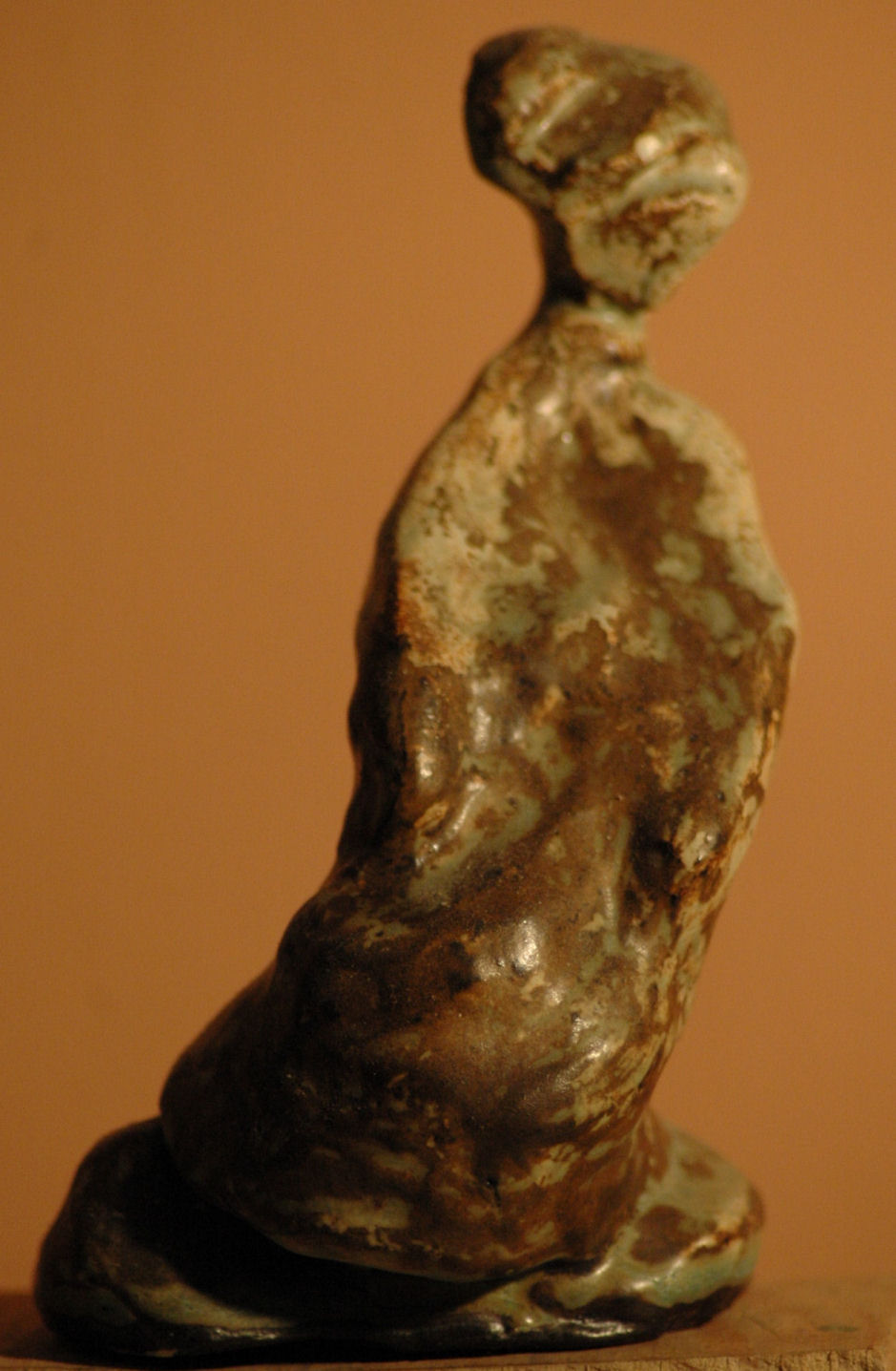
My ceramic sculptures have both abstract and figurative elements and I mix the two sometimes depending on what I am working on. Below is an example of my latest ceramic piece. The process of choosing the correct glazes combined with the correct temperature to fire the ceramic pieces is enjoyable exciting but also time consuming and at times frustrating as not always the ceramics come out as you think they would due to the machine not working properly or the glazes been to thin down or to thick. Still I do enjoy working in clay because it's a non rigid form of making sculptural work  and I see a lot of potential in it for conceptual work.                                                  

                                                         Mirta Imperatori copyright 2012

Friday, 9 November 2012

White Cube Mason's Yard: Magnus Plessen


Went and had a snoop around White Cube in Mason's Yard which is located in the centre of London near Jermyn street not far from the Royal Academy in between Piccadilly Circus and Green Park and near Fortnum and Mason so again we are talking about an expensive area. It's really accessible based in a courtyard. Mason's Yard used to be the home to the Indica Gallery where John Lennon and Yoko Ono met, not far in 13 Mason Yard was the Scotch  a major hang out for music events. Jimi Hendrix played there when he first came to London, they have now changed the name of the venue. It's very different to how it used to be in the 1960's in the times where there was buzz in the air and a lot of things where happening. I mean the White Cube in Mason's Yard looks again sleek and stylish and it adds more contemporary art to the area but lacks in the 1960's party experimental element. Sadly it's all about business this days with many galleries. Anyway I saw the exhibition of the German artist Magnus Plessen. All the paintings are made on canvas using bright colours he used the same colour range and style in all the paintings. The bright colours added a playfulness to the work a theatrical element to the fragmented figures. The paintings look like collages: he turns the canvas 90 or 180 degrees as a way of getting away from an individual view point to create multiple and simultaneous viewpoints of flat surface. I felt that the paintings worked better in the downstairs room as the room was wider  to accommodate his large paintings then the upstairs one where they felt a bit cramped.


Thursday, 1 November 2012

Fractal Geometry & My Digital Art.

According to this post from Sacred Geometry Mandala Art, Phytagoras described geometry as visual music. Music is created by applying laws of frequency and sound in certain ways. States of harmonic resonance are produced when frequencies are combined in ways that are in unison with universal law.
So sacred geometry is used in Tibetan Buddhist Mandalas & in building religious Cathedrals or temples.

These same laws can be applied to produce visual harmony. Instead of frequency and sound it is angle and shape that are combined to produce visual symphonies that show the harmonic unification of diversity. The same spiral is found across the universe, with spiralling galaxies using the same ratios.

What is the golden Ratio, in short the Golden Ratio is 1.61803399, this numerical value finds itself in many places in nature and the universe, if you have seen Leonardo' Vitruvian man it's the dissection of the human body using the Golden ratio. So Leonardo da Vinci can be said to be the 'Godfather' in the use of fractal mathematics in the arts as you can see from his work below.


Recently I have also been looking at fractal geometry and it's usages in computer graphics. As Computer Graphics artist use fractal forms to create textured landscapes that give more of a 3D look, mountain views but one can also use the more basic form of the Sierpinski Triangle above as part of one owns deign or the Koch Snowflake construction or like Paul Cezanne wrote to Emile Bernard in 1904: Everything in Nature is modelled according to the sphere, the cone and the cylinder you have to paint with reference to the simple shapes: than you can do anything. By contrast in Fractal Geometry of Nature Benoit Mandelbrot the Mathematician responsible for coning the name fractal had different view on this saying that: clouds are not spheres, mountains are not cones, coastlines are not circles and bark is not smooth nor does lightning travel in a straight line and he also said that to appreciate the nature of fractals recall Galileo's splendid manifesto that's said: 'Philosophy is written in the language of mathematics and it's characters are triangles,circles and other geometric figures without which one wanders about in a dark labyrinth.'


Some great fractals are also the Julia sets, devised by the French mathematician Gaston Julia (1893-1978). The Julia Sets are generated by applying an iterative non-linear process based on a very simple square-law function.
I am also interested in the space filling-curve: is a curve whose range contains the entire 2-dimensional unit square or n-dimensional hypercube Giuseppe Peano was the first one to discover one so they are usually called the Peano curves here is an example.
There are fractals in nature such as broccoli with their molecular structure and I have been  thinking to incorporate this different elements in my digital art work. At the moment my digital art work is not inspired from nature but I would like to introduce more natural elements to see if it gave my digital art work a more realistic or natural look and to experiment with patterns, or maybe incorporate photographs of objects into my digital art work
The challenge with digital art  is that it looks good on the computer screen but sometimes when one prints out the work it doesn't look as good or takes on a fantasy, fantastic style look like the examples below and it all turns into the same sleek 'fantasy kind of theme'. So I have been questioning by looking at other digital work, fractals, Op art on how to make my digital art work stand out original different from the general fantasy landscapes I see around but also printable that could be shown in an actual Gallery Space by using geometry as a way of depicting spacial depth this is still work in progress as in digital art the better the equipment one has the better the digital art work. There is also the challenge that digital art is still seen in a separate section from main stream art it would really be great  to break this boundary and that digital art become more main stream and accepted in main stream art as it is just another medium to make art and being creative.


                                          Mirta Imperatori Copyright 2012
                                         Mirta Imperatori Copyright 2012
                                         Mirta Imperatori Copyright 2012
This is my current digital art work that I have been recently working on. I have been experimenting with geometrical shapes and non to create spatial landscapes. I hope in the future to learn new programmes as this I am the moment is limiting the type of digital art work I am producing. For the current artwork I just used one computer programme I am familiar with.


Tate Modern:Tino Sehgal

Tino Sehgal performance art or 'constructed situations' are only done in the present time and he mainly uses the body (movement, interaction,human voice) to interact with the audience or the space around.
My friends that came with me to view the performance found this quite confusing they couldn't understand what was going on or where the performance was as there was no description of it any where and I tried to explain to them that's was the whole point of it but they still couldn't get it. So I would say that Tino Sehgal work is not for everybody even if requires the physical participation of the viewer but that is if the viewer understands what's going on or where the performance is taking place. I managed to have a conversation ( more it was listening to the performer's monologue about their personal life) so on some level we should have connected but I actually felt it was staged and contrived didn't feel genuine so it failed to involve me on this level thought I did find it more interesting when observing from afar when the group was singing yes so I was involved on some level then but not terribly excited as it felt really staged.The work of art can only be experienced if you are actually present but he does charge the Tate £50.000 to have it reenacted.He focuses on the physical evidence of the performance so one can not document the event but only remember it.

Hayward Gallery:Art of Change from China

The Hayward Gallery exhibition: Art of Change it's been the best exhibition I have seen so far due to the variety of artist on display and  also the discovery that Chinese artists don't only make paintings but also interesting conceptual work.
MadeIn Company is a creative corporation established by Xu Zhen Chinese Artist the youngest artist in this group exhibition.
MadeIn’s works seemed to me to involve performance and participation of the audience most of the time as they where several interactive installations such as Untitled (2007) which consisted of fitness machine that the viewer can operate with the use of a remote control to show the loss of identity in the modern man and social control and Just a Blink of an Eye(2005/2012) an illusion where  a person is suspended in mid fall.

Yingmei Duan uses predominately performance & the body in her work. She looks at the states of awakens and sleep and says that dreams are very important in her work. She also explores cultural displacement and social marginalisation. I found that in the piece above Happy Yingmei  where I met the actual artist singing & I was quite shocked and unsure on what to do but I found it moving and then in the pic below Sleeping, In Between and Patience (2004-2012) where she explores the interaction between the actual body and the interaction with the shelves and space around it and the floating mind.


I found interesting that Liang Shaoji's career as an artist started when he was 40 due to the Ccultural Revolution he was sent to work in the countryside in a factory. His work is made of silk worm and is about the traces of fleeting time. I found listening to the silk worms disconcerting but found interesting the combination of natural primary materials in his sculptural work and the concept of inner peace. From his work one can see he is very much in touch and works with nature.

 Sun Yuan & Peng Yu two artists that have been working collaboratively since 2000 they investigate the relation between things & work sometimes with shocking materials such as human fat tissue like in the Civilisation Pillar 2001 a monument to capitalism & vanity. i found their work interesting and fun due to the use of unusual materials, the large scale of the sculptures but also not knowing if the sculptures where real or not like so one  is forced qquestion reality & deception for example in What I am Doing 2012 where one can see a mix of natural history specimens and  fake rhinoceros made to look very real but are not.


 Chen Zhen he is another artist who experience the Cultural Revolution left China and lived abroad for many years. He uses everyday materials in his art work


He went to Brazil and made art work with  poor Brazilian children that live in shanty areas the candles are a symbol of life, hope of creating harmony in a place where there isn't harmony. It was made by the children and I found the combination of the simple designs, the bright colours  of the candles which are actually quite fragile as a material,moving as they also symbolise the fragility of the children's dreams for stability in the future.