Thursday, 28 November 2019

My Latest Photography Project & Exhibition at Photofusion in London.

I was selected for a photography project at Photofusion Photography Centre/Gallery in London which was really exciting. First I had to show them my portfolio of photographs, and do an interview to be accepted, which I was. During the project I took urban photographs around the area with cameras I have never used before, both in black & white and in colour, all under time constraint.  The first day of shooting was freezing cold; I was not dressed appropriately and the trains were delayed so I was nervous. I had the commuting problem all during my BA, my MA and now on this project. Basically being the only person commuting from far away, with trains constantly delayed,  and dealing with the bad weather, floods and all, but I did it. I remember my course directors at uni and other students telling me that they were really impressed with my determination to complete the course and do well, despite the long distance commuting.  Anyway I was really happy to be selected for this photography project that culminated in an exhibition.  I spent some time developing black & white photographs in the darkroom & doing some camera-less photography.
Below are a selection of the photos I took on the project.


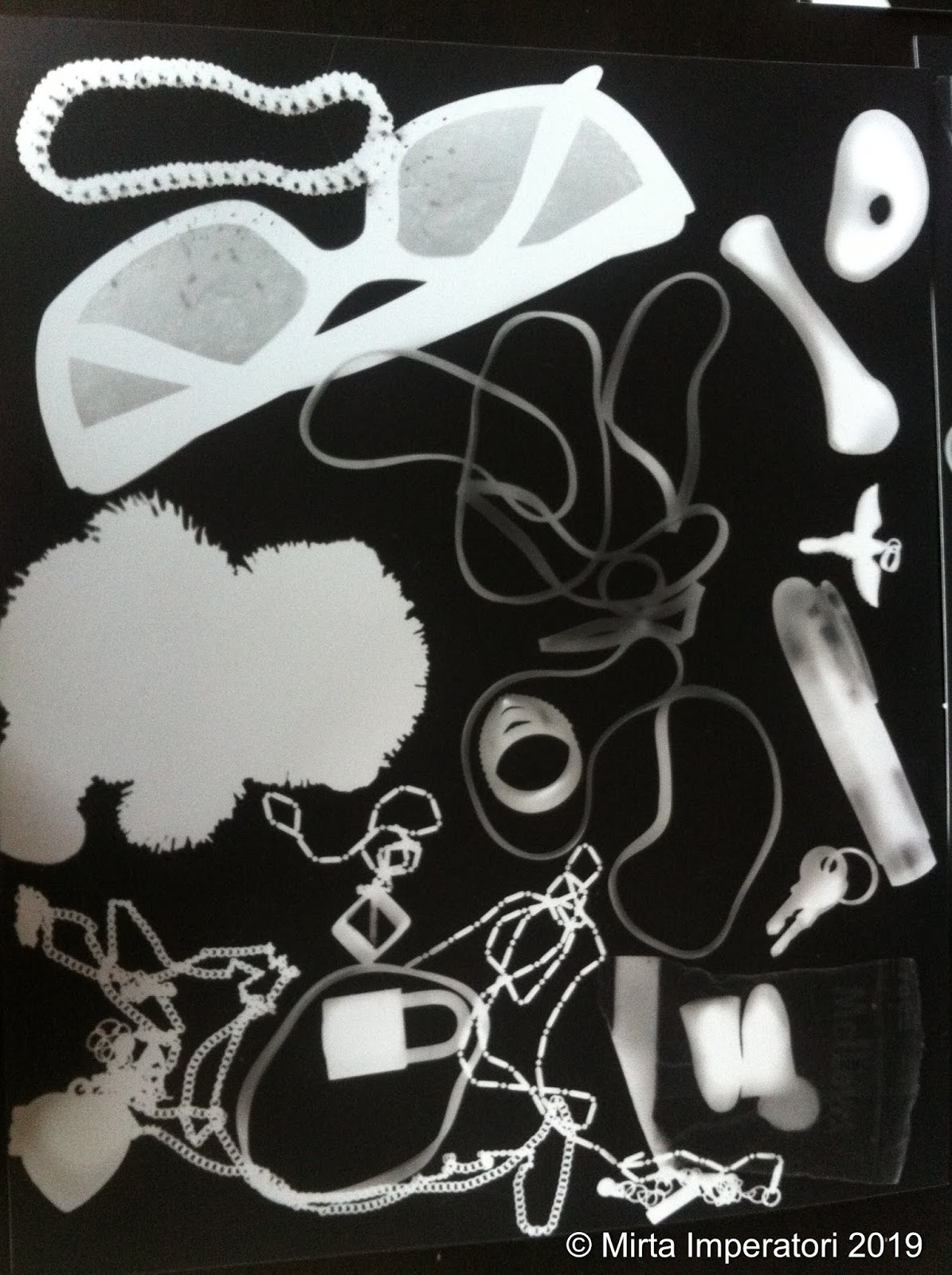
For part of the project we had to select items that we carry with us that say something about ourselves,  see below a sample of my camera-less photography.


 Below are three of my camera-less photographs that were selected for the exhibition.


Wednesday, 9 January 2019

Brexit reflections.

I have completed my Masters in Fine Art in the autumn of 2018. I have been asked: How does it feel to have finished? And I say: Great, a sense of achievement and relief as I don't have deadlines any longer and now I can write whatever I want on my blog (so I might be reviewing more films); but uncertainty due to Brexit has continued throughout the two years in which I have completed my Masters.

Many people don't know where to position themselves, both British and Europeans alike.

Three British friends of mine who used to live here, have moved to Europe: in order to be able to get a  European passport. Others living here don't know what to do, these are Remainers, they are deeply unhappy about leaving the EU, they feel European so they have been discussing whether to move abroad in case of a no deal Brexit. The Leavers are unhappy as well, as nothing is happening fast enough for them, and they feel betrayed by their own government; they want to pull the plug and regain sovereignty. Both Leavers and Remainers are unhappy with how things are going, for completely different reasons, some don't speak to each other any longer.

Some of my European friends here managed to get British citizenship as they have been worried about being sent back. Everybody is trying to protect themselves the best they can in different ways, in different circumstances. Some people don't know where they belong anymore.

During the Christmas period, on top of buying presents I was also stocking up on long term food incase of a no deal after it was discovered that the Government had paid millions to a ferry company that didn't have any ships.  Just today Parliament voted down extra money for the Government to prepare for exit with no deal…Things change daily in the news but not in people's lives.

All of this mess started with the financial crisis in 2008 and consequently years of austerity, job instability, lack of jobs and cuts to essential services in most areas (transport, police, education, libraries) that has affected a lot of people, pushing some people further into poverty, desperation and homelessness.  The economy is run by London but many areas outside of London don't see the benefit of it, hence Brexit.

There has been an increase in violent crimes, most recently a random murder at a train station. On top of this the migration crisis caused by wars and poverty abroad and the poor response to this  internationally combined with terrorist attacks, it is really a toxic cocktail.

People  have been killing themselves a lot lately here in England, it's become a regular thing hearing someone jumped in front of a train or from a building, it's happening so often that a minister for suicide has been appointed, I think we are the only country to have one…

Not long ago I saw a young woman who was trying to jump from the top of a building, she was standing right at the end of the building, a lot of people were taking photographs of her which I thought was appalling. The police were very efficient and moved us all backwards and cordoned off the whole area, I think they didn't want anybody witnessing her death close up. A friend of a friend of mine is receiving counselling after someone jumped in front of her while she was shopping inside a shopping centre in London, landing at her feet not on top of her. Now she is scared to go inside shopping centres or indeed outside of the house. We are not going through normal times.

I have noticed people getting angry over nothing in the street, shouting at each other or getting into arguments on public transport like never before. In some areas the transport has been atrocious lately with trains constantly majorly delayed, worst than ever I can remember, isolating people with no cars in their own areas  by drastically cutting the amount of transport available per day. In my friend's area they only get three buses per day and no trains?!

I have been meditating regularly recently for longer periods of time, with liberating and calming effect  and I have been busy drawing and painting. Keeping positive, exercising going about my life as best as I can but I still feel a sense of uneasiness, it comes and goes, I am just aware of it but I don't indulge in it. My friends say they feel the same at times.

So the Christmas holidays were a really good break from all of the above, I was invited to several Christmas lunches, dinners and events, it was great to be able to catch up with friends during the holiday period and have some fun. The end of the holidays and we are back to Brexit and what is going to happen next? An exhausting process but will Parliament actually agree to anything???

Words come under copyright Mirta Imperatori 2019.
If you are a magazine or newspaper and you want me to write an article for you please contact me.
I can be contacted on Twitter.

https://twitter.com/mirtaimperatori

Sunday, 19 August 2018

My Climate Change Installation.

I have been working intensely on my Climate Change installation. Below are some photographs from the exhibition; there are two rooms, each with a combination of photographs and objects. One has to experience it, it is not only visual but an experiential installation with a narrative.. To be explored!


Tuesday, 24 July 2018

This never ending heatwave + Joan Jonas at Tate Modern Tanks, until the 5th of August.


London's green grass has gone yellow photo courtesy of the BBC

This never ending summer we have suddenly turned into California with dry yellow grass everywhere, see pic above.
I cannot recall in my lifetime a continuing heatwave like this in England. The Met Office has issued an Amber warning which they call the Mediterranean Melt Heatwave, telling people not to go outdoors! I am preparing for my first big installation and it is partly about global warming.
I have done weeks of going back and forth between different large DIY shops in order to source materials. I have noticed with the hot weather people are more friendly and talkative.
In the supermarket there are rows of empty shelves: no lettuce, avocados or tomatoes. I am careful with water, I don't use more then I need; they might put a hosepipe ban in place soon. In the street today I saw an elderly lady who had collapsed, with paramedics  attending to her. Buses were delayed, by mistake I took the wrong bus, there was no number at the front and I assumed it was the bus I usually take as it was in its position, I realised too late they had swapped, it took me two hours to get to the appointment, I arrived angry and deflated, and it's only Tuesday...
It's funny how in the heat people change. Also on the wrong bus was a man I normally see on my regular bus; he is usually very smartly dressed and composed. Now, for the first time, I saw him completely dishevelled, shirt wide open showing his bare chest, he sat inside the bus and took his shoes off, two people next to me did the same.. what a sight! I kept my trainers on and my shirt... I didn't want to cause an uproar! Still I understand them - the bus was an oven, acrylic seats, windows that barely opened to let any air in. Little sleep at night; the combination of heat and noise is not conducive to sleep - at least there are no mosquitos!

Video Installations by Joan Jonas photo by Mirta Imperatori

Anyway, I went to another exhibition at Tate Modern on the hottest day to take my mind of things. As always I had my bag checked by security going in. It was nice and cool inside Tate Modern is an island of peace. I started regaining my energy levels which had been a bit weighed down by my constant thinking about the deadlines. I viewed the multi screen video installations by Joan Jonas titled Reanimation and Wind in the Tanks; I didn't know what to expect. Joan Jonas is a leader in performance and video.
The piece, Reanimation, was inspired by Halldor Laxness' novel Under the Glacier, 1968. When you enter the room it is dark and there are several screens showing scenes of nature including mountains see pic above. This is a multisensory work, though not all embracing like the work of Pipilotti Rist.  
I could move close up to the screens or further away from them. Sound and images overlap but not in overwhelming way. Strangely enough I can't recall the sounds, I didn't realise there were any sounds but in the brochure it says a 'Yoing song'  was playing in the tradition of the Sami population of Norway, written and performed by Ande Somby with other pieces by Jason Moran. It shows the beauty of glaciers and the natural landscape which I found surprisingly relaxing, and which interact well with the images on the large screens. The videos were shot in Norway, on the the Lofaten Islands, and show the snow covered mountains under different light conditions, with images of seals, goats and fish. 

Installation by Joan Jonas photo by Mirta Imperatori
There is a sculptural unit set up on the floor opposite one screen, it is a crystal sculpture in action as its pieces move shimmering on the floor in all directions, see pic above. It has a physical, material quality to it; it spoke to me of a child's plaything and of the use of lights in the 1970's; this is counterbalanced by the images on the screen, a mix of ethereal, techy, and physical. The video is about the melting of glaciers, the artist reanimates with her own hands the melting process, showing how life is delicate and how complex is our relationship with nature. This particular piece is called Ice Drawing where she uses ink and ice, the ink spills onto a lean surface and the ice melts. This is a staged environment which interacts well with the images on the large screen.
I was taken aback by the high number of people taking photos of themselves within the work, then to post on Instagram.

Wind by Joan Jonas photo courtesy of Pinterest

Wind is a silent movie and is positioned separately in the space from the other screens so as to make you just focus on it alone, see pic above. It shows a beach on Long Island, filmed on a very cold day, it is a performative piece featuring the artist herself with another artist, Hollingworth, and another larger group in masks who are trying not to be overpowered by the strong winds; the way they move, trying to stay upright, gives playfulness to the piece, it is comical, it's like being part of a live theatre. Her work is influenced by Surrealism and Japanese Noh theatre and she has a keen interest in climate change which is reflected in the work.


Saturday, 14 July 2018

Christo and Jeanne-Claude, The Mastaba at the Serpentine Gallery & Hyde Park. Recommended

The London Mastaba By Christo - Photo by Mirta Imperatori
I am very happy that I managed to see the Mastaba floating in the waters of Hyde Park; I see it as an inspirational work, showing what can be achieved when one puts ones mind to it. I didn't think I would have such a happy reaction  when first seeing the Mastaba from high up on the Serpentine bridge. The floating, colourful sculpture which was funded completely by Christo and is composed of 7.506 barrels, is one of his largest barrel works. I was surrounded by tourists from all over the world, who were pointing at the colourful Mastaba in amazement saying things like: what is that? I have never seen anything like it see pic above. But first of all let's start with the exhibition at The Serpentine Gallery, which shows all the work put into the Mastaba through large sketches and 3D models, and how they transform the surrounding landscapes, all over the world, including in this project in Hyde Park. The Mastaba, the meaning of the word from Arabic is 'bench', is of trapezoidal form with inward sloping sides, it naturally forms when cylinders get stacked together. The exhibition shows the different Mastaba proposals for different sites around the world, not all of which have come to fruition.

The Mastaba sketch by Christo & Jeanne-Claude courtesy of Pinterest

The exhibition focuses also on Christo and Jeanne Claude's history of working with barrels, which are affordable materials that also have a commercial use.  The exhibition spans 60 years, starting from Christo's studio in Paris, and includes work I have seen only for the first time. I have seen their larger project in Italy which again was fantastic. The barrels in the exhibition resemble totems of rust as they are put one on top of each other and they are rusty, some large, some smaller, see pics below.
Work by Christo & Jeanne-Claude photo by Mirta Imperatori

Work by Christo & Jeanne-Claude photo courtesy of  Pinterest

Work by Christo & Jeanne-Claude photo courtesy of christojeanneclaude.net
In 1961 they exhibited at Galerie Haro Lauhus in Cologne, the work was titled Dockside Package and includes rolls of industrial paper held with ropes and covered in tarpaulins. Also in 1961 they showed Stacked Oil Barrels, oil drums assembled together into a large structure see pic below; all of this is documented in the exhibition.  I was particularly drawn to his smaller works: the empty wrapped cans, covered as though they were a package, or a ghost of the original package; this specific project is shown indoors but a lot of their other projects with barrels are outdoors. They temporarily disrupted Paris infrastructure on 27th June 1962 when they created a wall of barrels which blocked people and cars. 

Stacked Oil Barrels Cologne Harbour 1961 by Christo & Jeanne Claude
The Iron Curtain by Christo & Jeanne-Claude photo courtesy of Pinterest

This was in protest at the Berlin Wall, which had been constructed in 1961 and spoke of Christo's personal life as a refugee see pic above; he escaped the Soviet Bloc to the West in 1956 via Vienna and Geneva and then moved to Paris two years later. I find this guerrilla side of their work of particular interest as it relates to mine. He stopped wrapping barrels in 1962. In 1964 he and Jeanne-Claude (who passed away in 2009) moved from Paris to New York where Christo still lives today. They successfully completed the Mastaba at the ICA Philadelphia, which was made of 1,240 oil barrels and titled Oil Barrels Mastaba see pic below, and from this they worked to realise a bigger one. So they were focused on increasing the scale of their original project. Barrels were positioned on top of each other in different shapes, sometimes forming fragile, precarious structures, culminating in Barrels Structure (1968) which was build in the shape of a triangle. In the exhibition there are also sketches of The Mastaba, the project for Abu Dhabi see pic below, created in 1977 to be  experienced in the desert dunes. This is still an ongoing project which, if realised, would be the largest sculpture in the world. 

By Christo & Jeanne-Claude 1,240 barrels - courtesy of Pinterest

The Mastaba by Christo & Jeanne Claude  courtesy of Pinterest

The Mastaba in Hyde Park is not static as are some of their other works; it interacts and changes with the surrounding landscape. For example the colourful barrels reflect colour into the water, and the floating Mastaba itself changes in colour depending on where the sun is. It's an artwork for the people as it is not part of the surrounding architecture and it is self funded, it is 20 metres in height, 30 metres in depth and 40 metres in length. The sides of the barrels are red and white and the ends of the barrels are different shades of red, blue and mauve; the whole structure is supported by a steel frame, and was put together by a specialist team. I have to say that from the bridge I could only see the blue and mauve of the Mastaba sometimes just blue or mauve depending where I was standing and depending on the sunlight. It's fun due to the the colours and it contrasts with the grey traditional buildings of London; it's geometric, abstract, and makes you think of op art;  it can be appreciated by anybody.

The London Mastaba by Christo photo by Mirta Imperatori

It is an environmental piece as well, as the colours change with the weather. The barrels made me think also of the politics of oil,  a very current topic at the moment. One can get a closer view of the floating sculpture by renting a boat, I saw plenty of boats around it. Christo and Jeanne-Claude made the impossible into a reality and this requires patience and vision; it took two years to be produced, the barrels are custom made and recyclable. Christo says that after the Mastaba is dismantled there will be funds made available to improve the biodiversity of the Lake's ecosystem. On the Serpentine bridge there were security staff, checking that people didn't do anything silly while on the bridge; they were giving information about The Mastaba in an entertaining way. It was a fun day out in the heat, the display lightens up the city. 

The London Mastaba by Christo photo by Mirta Imperatori

The exhibition is well presented, combining initial sketches with the finished works, and gives a good insight, through the various items on display, into the artists' working procedures.

Friday, 29 June 2018

Olaf Otto Becker's photographs at Huxley-Parlour Gallery.

Summer has finally arrived, it's wonderful to wake up every morning and a see a clear blue sky and the sun shining. The problem is when you step out into the outside world and you find out that trains are delayed or cancelled and it takes you twice as long to get across literally anywhere. You are amazed to discover that train companies use tracks that don't expand with the heat like they do in hot countries I guess they do this to save money as they would require less maintenance then expandable tracks. It seems the train service here only runs when the weather is perfect. If it is too cold or snowy or windy trains don't run properly and in the summer it is the same. I can't remember when was the last time I took a train  that was running on time, they are generally delayed. On the hottest  day of the year I found myself stuck on the train for two hours on a journey that usually should take half an hour. The driver first took us on a grand tour of the area, then the train stopped for nearly an hour in the heat just in front of the next station, we could see the platform but could not get off; the driver kept whispering something but we couldn't hear exactly what. If outside it was 28-30C inside it was 40C, we were gasping for air. I was really glad when we finally reached the station which was in a stage of complete chaos, I got out as quickly as possible. It is only when things are majorly disrupted that one understands how over-crowded London is. My friends told me that on the road it was no better with short journeys taking up to 3 hours long.

Photo by Olaf Otto Becker courtesy of Huxley-Parlour Gallery
The exhibition of Olaf Otto Becker's photographs at Huxley-Parlour Gallery near Piccadilly displays pictures taken during his many trips to the western coast of Greenland. He used a rubber raft to move between places while using a large format camera to take pictures of the glaciers, documenting the effects of global warming on the coastal landscape. He also took photographs of isolated, vividly painted wooden houses. His main preoccupation, however, was to document the ever changing landscape of the glaciers and icebergs. 

Photo by Olaf Otto Becker courtesy of Huxley-Parlour Gallery
The photographs show the vastness and magnitude of the glaciers and icebergs; they are calm, meditative pieces, and again they made me think of Tacita Dean's work,  in particular her mountain peaks which I recently viewed at the Royal Academy, all about the idea of the sublime. Each photograph has to been seen in the context of the others; they create a story, the icebergs turn into living sculptures, they are majestic, but still also scary due to their size.  Some of the  photographs have been taken from below the icebergs, looking up at them,  making them look even bigger;  this is a specific narrative in which the glaciers and icebergs are the central figures see pics above and below.

Photo by Olaf Otto Becker courtesy of Huxley-Parlour Gallery

He documents the evidence of over-population and the consequences this is having on the natural landscape, with global warming, and highlighting how the land and water are becoming scarce in many areas of the world. The photographs reminded me of the painter Caspar David Friedrich in their composition; he was a 19th century romantic landscape painter, whose contemplation of nature, and through it getting close to the sublime, produced pictures where the viewer is encouraged to experience the sublime potential of nature. His winter landscapes are solemn and still. 

Hochgebirge painting by Caspar David Friedrich courtesy of Pinterest

The Sea of Ice painting by Caspar David Friedrich courtesy of Pinterest
The colours of the icebergs are so clear and beautiful that they make them almost feel unreal, singling out pieces of the icebergs, showing them in one shot and making them feel more like relicts in the still water, imparting a fragility to them that suggests they will soon disappear. All these chunks of icebergs floating along that will soon no longer be there, where the wooden structure of the houses actually looks more solidly based then the glaciers themselves, this is scary! 

Photos by Olaf Otto Becker courtesy of Huxley-Parlour Gallery
The wooden houses with human belongings spread around them look like they don't belong there in the midst of the stillness of the landscape; this is quite poignant. The houses and floating icebergs are juxtaposed next to each other in the exhibition and they are all in white frames. The icebergs are like cut flowers they are living and dying at the same time.
This is an interesting and thought provoking exhibition about the consequences of global warming.
https://huxleyparlour.com/exhibitions/olaf-otto-becker/

Saturday, 23 June 2018

Tacita Dean's exhibition, Landscape at The Royal Academy of Arts.

I enjoy working at night, it's the only time when it's quiet. That's what I felt while going to Tacita Dean's exhibition at the Royal Academy of Arts. Her work is grounded in nature, it slows you down, it removes you from the hectic life outside. In the first room there were her works on slabs of charcoal that make you think of the combination of light and air, but also of the material itself, and of earth. Her exhibition, Landscape at the Royal Academy, is part of a three part exhibition of her work. The  other two works are: Still Life at the National Gallery and Portrait at the National Portrait Gallery. I have not seen the other two exhibitions so I cannot comment on them. I will just focus on the one at the Royal Academy. The earth is present in it's physicality, both in the chalk drawings and also as found objects,  stones which are displayed in a cabinet. 

Antigone by Tacita Dean photo courtesy of the Guardian.

There is also a new 35 mm film which shows that she continues to be  a supporter of analogue film. This film is  entitled Antigone. It is presented  in split screen mode giving multiple view points,  it's nearly an hour long,  and the film is edited in the camera itself. We see a man walking in nature with a stick,  and close ups of  volcanic points in Yellowstone National Park see pic above; all is peaceful. We move from Wyoming to the town of Thebes in Illinois and to the first courthouse where Abraham Lincoln practiced. The movie and the work in the exhibition force you to slow down, they make you think of romanticism and the sublime. Dillane, the man with the stick, represents Oedipus in Greek mythology who killed his father and married his own mother, Jocasta. They will have four children together including Antigone his daughter. Oedipus became King of Thebes and after Jocasta killed herself he blinded himself and left his city. In the film he seems to walk across land with no aim while wearing a pair of glasses, despite the fact that he is blind. Meanwhile in the other section of the film Ann Curson discusses aspects of Greek mythology.

Antigone By Tacita Dean courtesy of Pinterest

I didn't paticularly identify with Dillane as Oedipus; rather than tragedy he actually made me think of the romantic walker who walks on his own as represented in Rousseau's the Reveries Of The Solitary Walker and also in Thoreau's Walden, this romanticised view of wondering or living in direct contact with nature. The close ups of the volcanic points force you to slow down as they are filmed in slow motion,  The images are meditative and grounded see pic above, they clash with the story of Oedipus & Antigone (which is also the name of Tacita Dean's elder sister). The film is not just about the story but also about light: dying light, the first glimmers of light, the eclipsed sun. Sometimes we are in several places at once, the two films overlap.

Montafon Letter by Tacita Dean photo courtesy of Pinterest

The first room is dominated by snowy mountain peaks, one of which takes over the main room due to its vastness. It made me think of Monet's work the Water Lilies which I saw in Paris a while back. Tacita Dean with the snowy mountains has made her own version, it is more minimalist and austere and was created using traditional chalk and blackboards; it is labour intensive work. Entitled Montafon Letter see pic above, the picture of the mountain peak refers to an avalanche that burried a village in the Austrian Alps in 1689. A second avalanche apparently burried the priest and a third avalanche uncovered him. Here is nature, the mountain, seen as sublime but also powerful and unpredictable, the essence of danger. It is composed of nine blackboards, joined together and more than seven metres wide. Hidden in its surface are  written notes and apparently these are about Brexit. The blackboards are not fixed with fixative as it is usually done when using chalk.
There is also a series of smaller chalk pencil drawings to accompany the main work. So we have earth, clouds, stones and light all together. The work is not based on one place but shows Tacita Dean's extensive travels from Cornwall to the USA. She observes nature, the changing weather, and her ongoing relationship with nature, places, and people she encountered. At the same time she looks at the past and our relationship with history, in particular the history of painting.

Work by Tacita Dean photo courtesy of Pinterest 

In the second room are lots of tiny leaves, inside a glass case; these come together to form a landscape see pic above. They were collected from 1972 which means she started collecting them when she was seven years old. In the exhibition there are also smaller slates and chalk drawings of clouds see pic below; chalk here is sprayed and there are inscriptions such as Where England?  These are materials mined from the land, possibly referencing the Victorian period of the Royal Academy, as in Victorian times they used slates with chalk in schools.

Work by Tacita Dean photo courtesy of Pinterest