Sunday, 8 October 2017

The Natural History Museum Kensington Incident & Wade Guyton at the Serpentine Galleries.

Life in London is becoming more and more crazy, between terrorist attacks & weird incidents like the one I experienced this Saturday opposite the Natural History Museum in Kensington.
I had just come out of Kensington Station & I was walking up the main road when I got to the intersection where the Natural History Museum is and there was a pile of cars on the main road. At first I thought it was a robbery, one black car had crashed into a grey car and was facing the pavement with the driver trying to escape. I saw him being held down on the ground by three security guards, there was blood coming out of his nose, they were waiting for the police to arrive, I saw a pair of shoes behind him and the door of the black car wide open which made me think that he had tried to escape before he got caught. The official story in the papers yesterday from the Government was that this was a traffic accident. I am sorry but in traffic accidents you don't get people mown down by a car, nor do you get a guy being forcibly held down by security people, see the pic I took. 

                                                        Photo Copyright Mirta Imperatori

I saw a woman lying down on the floor next to the Museum helped by several people, she looked shocked. Then I read in the papers that 11 people were injured by a car. There is more to this story than meets the eye.  See how it has been reported in the media.
http://news.sky.com/story/kensington-crash-witnesses-tell-of-mass-panic-11071245
https://www.standard.co.uk/news/london/south-kensington-police-descend-on-area-outside-natural-history-museum-after-car-hits-pedestrians-a3652986.html
I quickly walked away from the scene because I could hear the police descending upon us so I decided to make a quick exit out of there before the whole area was put in lock down. I was just thinking that I had two near death experiences in the last couple of weeks. Just a couple of weeks ago I was walking on a road, I passed a rather large tree literally on my left hand side when suddenly I heard a huge thud behind me; I turned around and saw that the whole tree I just passed had come down and had crashed on top of a car that was parked there, causing considerable damage. It just missed me! 
Anyway I helped a Chinese couple redirecting them, I told them not to go where the incident had just happened, that the police were in the process of sealing off the area, I told them to go to High Street Kensington instead, they thanked me for my help and quickly moved on. So after all of this had happened I was really hoping to see a good exhibition at the Serpentine Galleries. Sadly this was not to be the case. 
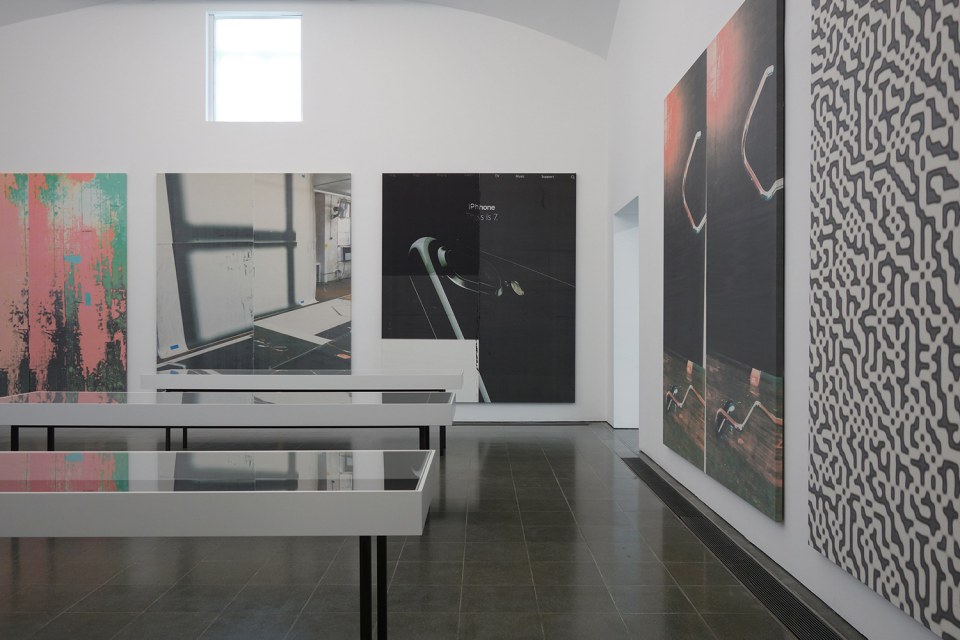
                                                      Photo by Serpentine Gallery

The exhibition was of Wade Guyton see pic above and below.  His works are made using IPhones, cameras, and an inkjet printer. All the images were printed on canvas on linen, some images were blurred, he says they are a record of their own making. Yeah right, he is making them just using a machine, nothing new here. In the brochure it says that he analyses our relationship with digital media. I found the work in the exhibition outdated, not current, and a tautological exercise in blandness, the Gallery photographs of the exhibit actually look better than the originals. The original images don't give you anything back, just  accidental flatness.

                                                       Photo by Serpentine Gallery

This type of art is for corporates that want to buy this type of work to offset their taxes because there is really nothing else to the work, not the ones I have seen at the Serpentine Galleries on this occasion. What! You take pictures from your Iphone or inkjet printer, not even well taken and you just put them on a canvas.... how ground breaking! I mean there are loads of people online that do this and do it better, their work may not be bought by the big guns in the art world because maybe they don't know how to promote themselves, sell themselves with a clear package but that doesn't make it any less valuable. I have seen much better stuff inside Universities in the UK, more up to date with what is going on in digital media than this exhibition. The only interesting piece I found in this exhibition was of several canvases stacked together, the front was different from the sides, so it turned itself into a sculptural piece, most of the canvases were of  a standard size or large. There were also tables with more images inside printed on paper not on linen like the canvases, I find this pretentious, the images were of really poor quality, he could have left them out; by putting them inside the table as they are small and not of good quality it just didn't make me want to look at them. Why  would I want to look at something of poor quality inside a see through white table on poor quality paper at a lower level? The tables were smart tables like you see in pretentious establishments for wealthy people, bizarre! I find the concept of  this work poor. They call it conceptual paintings and that he goes against painting. He works with the machine but don't be fooled, he is no Gerhard Richter.  I have seen better work done online by strangers! It made me ponder the fact that if you finally get picked up by a big gallery you can really sell anything and pass it for innovative and then get more people to buy your work no matter what nonsense you give them - they will buy it because the big gallery has taken the work and given it value.. finally I just want to say that if a woman did this same work she would not be taken by the gallery.
I wasn't in a good mood when I came out of this exhibition. 

Tuesday, 26 September 2017

Living Cities Exhibition - Tate Modern: Ai Weiwei, Stephen Shore, Birdhead.

It's often better not to react emotionally to a situation but stand back and think before one acts rather than react impulsively. There are men in power who react like a child who has not mastered control of his emotions. The only thing for sure that happens when this type of personality gets in power is conflict, the only way they can truly be and feel is through creating antagonism, division and utter chaos. I was just thinking this when I read the world news. I strolled to the Tate to have a coffee and see the exhibition about Living Cities on level 4 of the new building at Tate Modern. Wouldn't it be great if such men could engage in art, the environment, helping others make the world a better place instead of handling their egotism and rage into creating more conflict and misery.

                                                               Photo Tate Modern

The exhibition shows a selection of artists from around the world and how they experience living in the city. It's a reflection on how the city can be a utopian place involving communal living, or a place of protest. Ai Weiwei has been a positive example of how an artist can create wealth for others through his work by creating  a studio where assistants worked on his projects in the city he lived in, Beijing. The studio space was an oasis but now he is living in Berlin as a refugee (but this was not mentioned in the video shown at the Tate which is basically now outdated, see link below).

http://www.tate.org.uk/context-comment/video/ai-weiwei-on-beijing-artist-cities

In the show there is a video of him in his former city Beijing. At one point they are shown putting red lanterns around surveillance cameras in the street outside of his studio. Ai Weiwei says it to high-light them, to make it more clear that you are  under constant surveillance, that there is no freedom of speech. In the video the buzzing of a busy city, Beijing, is contrasted by a tour of his studio where they are seen working on a project involving surveillance cameras made out of marble and we see the courtyard that looks like an oasis of peace. The neighbourhood around is oblivious to what goes on inside of the studio space. He called his studio 'a station from outer space'; it's shut in, behind a metal gate, an art city within the neighbourhood  of Caochangdi the 5th ring of Beijing and he has created a similar environment in his current home of Berlin.

                                                               Photo Tate Modern

Another piece that interested me in the exhibition is the photography by American Photographer Stephen Shore, as I also take photographs of the ordinary and every day life. His photographs consist of his travels in different American cities in 1972, 1973. He photographs the ordinary, the every day in life. The photographs are displayed closely together and framed, this requires your attention as a viewer, it forces you to go close up to them to be able to see them properly, individually and not as a whole. They are photographs of ordinary people, walking by in their daily lives. He travelled across the USA, discovering Middle America as he had been mainly based in New York. His photographs are intuitive and they are to do with light and colour. He is a pioneer in colour photography see pics below, he also photographs the overlooked. They include street photographs, motels, basically what is right under our eye but that we do not see. The every day in his colour photography was not appreciated in the 1970's but his photographs became more appreciated later on. To be noted is that he used a view camera for documentary photography which was unusual. 


                                            Copyright Stephen Shore taken from Pinterest

Opposite his work are the photographs by Birdhead which is made out by Ji Weiju and Song Tong who work together and take photos of the every day in Shanghai. Their photographs are very different from Stephen Shore's, first of all they are monochrome and printed in large format on paper and hung not framed. There is no narrative in their photos but the subject of the photos creates their own narrative; like Shore they photograph people going about their daily life, the every day: potted plants, vegetation, tree trunks next to architectural subjects such as bridges, new apartments in Shanghai. They wander off and destroy the film after printing so it becomes a limited edition.
They use an analogue camera, the subject matter of a young person's Shanghai, directed by their own formative experience.
If you are a Gallery or a Magazine and you are interested in my work contact me here:
https://twitter.com/mirtaimperatori


Wednesday, 20 September 2017

The Parsons Green Bomb in London & Fahrelnissa Zeid 's Exhibition at Tate Modern.

I am trying to keep some sort of normality in a period which is not really normal, the day after the Parsons Green bomb I went to the Tate to discover level 4 of the new building. I asked a friend if she wanted to come and she told me she was too scared because of the bomb at Parsons Green. Another friend said the same, they didn't move from their areas. So I went on my own, because maintaing a normal way of living for me is the only way forward and I don't let such events put me off, I think one is still more likely to be run over by a car rather than anything else. We still have more people dying of depression and suicide due to the poor level of access one gets for mental health in this country. But yes, it wasn't a normal day with the anti terror police visibly deployed across London and on the tube the driver was shouting down through the intercom system at each stop: 'If you see anything suspicious contact the police' and gave the number. I was thinking that by the end of his run the driver would be voiceless. Myself and the people opposite each other were just staring at each other like lemons, hoping that it wouldn't happen, literally to be in the same compartment or in the tube with a bomb. I think the people on the Parsons Green train have been incredibly lucky because the bomb didn't detonate properly. It will take time for them to recover because burn wounds even if small are very painful. I wish them a speedy recovery but it will take time. I remember I went to a talk by a survivor of one of the earlier London bombings. I was really impressed by him and his own experience of the event and how it had affected him. I will never forget it. I was happy to see security at the Tate, checking bags equipped with a metal detector, they were everywhere. But it made me realise that we are rally going through a mad chaotic period, and it is important to stay calm and to keep going. It can actually make you more focused and present if you don't give into fear. Anyway it was great to see London busy as usual, people walking around like normal. It was the first time I momentarily enjoyed it as generally you won't see me in a busy place with lots of people. So I got to the Tate, no problems, I had a nice lunch and luckily this time I didn't get stuck in one of the lifts, and it wasn't busy. I saw the exhibition by Fahrelniss Zeid, the Turkish princess artist. She was married to Prince Zeid al Hussein of Hashemite Royal Family who were assassinated in a military coup in Iraq. She was educated both in Paris and Istanbul and was part of the Turkish avant guard of the 1940's. She was one of the first women to be taught as an artist in Istanbul.


All the paintings in the exhibition were large and made of vibrant colours, interlocked with each other, but not in a static way.  There is movement in her pure abstract works, see pics above and below, taken from Tate online. In the first room there were also her portraits, which were made in a more realistic style and were very different from her abstract work. Her portraits usually covered family and friends. In the second room, I saw her abstract paintings made of intertwined black and white lines and yellow and red lines as found in islamic Byzantine art or mosaics see pic above from Tate online. In the third room I saw her sculptural work. I find this particular work fascinating with the combination of completely unrelated elements - she was painting on turkey and chicken bones which at a later stage she cast in polyester resin. She also used to paint on stone. In her final years she turned her home into a formal art school.
Coming back from the exhibition, heading towards my friends' area, the journey was chaotic. Inside the train there was a fight between a group of drunken men. The train suddenly stopped, not moving at all so we were all thinking oh dear it's engineering works, leaves on the tracks, a body on the tracks..
Instead the conductor shouts down the speaker: apologies for the delay: we are waiting for the police to take away a group in first class?! Generally in first class there is hardly anybody, I mean you might see one person in the whole compartment nobody wants to pay extra for the privilege apart from a few wealthy people using it regularly. Suddenly the train started moving again  and we didn't see any police coming  on but we soon realised that all is not ok as a bunch of aggressive men shouting at each other walk through our compartment and stop near the main toilet and their shouting grows louder. Luckily I am sitting next to a nice, fit stranger, a guy who is looking out for me and he says: 'are you ok?' I reply 'yes I am thanks for asking'. He says: 'they are making a lot of noise at the back glad we got headphones to listen to music' which in a way made me laugh. They were having a fight at the back while we were listening to music trying to ignore them. What a trip!


Saturday, 19 August 2017

Tate Modern Level 2: Gyorgy Kepes.


Caught the exhibition of Gyorgy Kepes at Tate Modern. I generally go inside the Tate to see something specific – I don’t just wander around in an aimless way from room to room. On this occasion I wanted to see the work of Gyorgy Kepes who was interested in the relationship between art, science and technology.

                                        Gyorgy  Kepes - Pinterest

His photographic work covers both scientific and mechanical objects but he also took photographs of nature, he was interested in light, particularly the balance between light, space and movement. In his photographs he juxtaposed everyday objects such as bread, scraps of paper, gauze, stones, leaves and feathers, for example, creating abstract works. He was interested in capturing the different shades of light onto photographic paper see pic. below. The photographs in the exhibition are presented horizontally at eye level, and are neatly framed. The curation of the exhibition shows the evolution of his work in a linear manner.

                                        Structure Photogram, Tate Org.

Hi photographs are carefully composed, done without the use of the camera but by exposing objects to light on photographic paper. None of the images is large scale, but small to medium scale as one would expect from this typical process and that specific period. The photographs in this exhibition are all from the 1930’s till 1940’s taken at the Institute of Design in Chicago. It’s a pity that his later work was not included in the exhibition as it doesn’t show his further development through his photographs between art and science/technology. Through his work and experiments he hoped that it would help scientists find new representations for visual models. In his later years he was also concerned by the negative effect technology could have on the planet and the possibility that advanced technology could destabilize men’s biological nature with catastrophic consequences. The exhibition is cut short and it only includes works from his early period; whilst it could have been a bigger exhibition, it is a compact introduction to him and his early work for the novice. He was also part of another exhibition at Tate Liverpool titled Surreal Landscape.

                                        Leaf and Prism, Tate Org.

Throughout his work he searched for points of contacts between art and science, and he discovered this in nature as a common discourse see pic. above.
I am particularly interested in his photographs as I am currently working in photograms as well, exploring abstraction. His photograms are rather abstract and I have a keen interest in the relationship between technology and photography.  At the beginning, he didn’t see technology in itself as negative, he was experimenting. But later on he warned against unrestricted proliferation of technology. He believed science could help us see and understand the connection between the macro and the micro in the world. He was also interested in how we harvest and how we create and channel energy. His work has been acknowledge as having critical impact on the development of digital images on our digital devices.
The room with his work was located on level 2 of the Tate Modern’s East side of the building. Several people from the Tate didn’t know who he was or where the room was located. Finally I found two people from the Tate who knew at least where the East side section was after 30 minutes of searching. It is the first room as you come out of the escalator just to save you time on level 2 of the main building, I went by mistake to the west side.
Yes I spent half an hour looking for this exhibition and I realized how easy it is to get lost even in the old wing of the Tate Modern!


Sunday, 13 August 2017

Whitechapel Gallery, A Handful of Dust.


With a sudden burst of energy I was able to view the exhibition at the Whitechapel Gallery, ‘A Handful of Dust’. The exhibition is on the upper level and to get to it one has to go through another exhibition on the ground floor. The first photograph I saw in the A Handful of Dust exhibition was one by Man Ray taken in Marcel Duchamp’s studio in Manhattan where he took pictures of a large piece of glass covered in dust. Duchamp allowed dust to accumulate over his work called the ‘Large Glass’, also known as ‘Dust Breeding’ see pic. below. 

 Large Glass or Dust Breeding Man Ray, Duchamp, photo Whitechapel Gallery.


Duchamp asked Man Ray to record the progress. There is no specific subject matter or scale.  Man Ray wrote that the image through his camera lens: ‘appeared like some strange landscape seen from a bird’s eye view’ so it appears as an aerial shot, and is pervasive without a specific subject or an original sculpture. As with this photograph one can see photography’s ability to baffle the viewer’s sense of scale, which is one of the elements I am working on with my photographs. In the same period T.S. Eliot published the ‘Waste Land’ where he wrote: ‘I will show you something different from either/your shadow at morning striding behind you/or your shadow at evening rising to meet you’. Basically he is showing how dust can create fear as it pollutes our air. Man Ray describing his photograph said: ‘I would rather photograph an idea than an object, and a dream rather than an idea’. It operates on two levels both the particular and the abstract. The resulting photograph was made while they were out for lunch so with an exposure of about an hour. Between the 1920’s till 1940’s different avant-garde journals used the image in varying frameworks while making changes to the title and editing. In this way the image The Large Glass has became something else. While Man Ray’s photograph was seen as an original in his own right and was seen as a photograph in Duchamp’s case his work is a means to document the production process of The Large Glass, so his interest is in the process. There is a duality between the two. The work creates an open debate about its function and Duchamp’s intention. The Photograph raises more questions then answers for example: is it a photograph or a document? Is it about a concept or the process or both? Or is it just Duchamp’s interest in the mundane ‘dust’. Because of this I found this photograph fascinating; I kept going back and back relooking at it, I saw others doing the same.
  
Photo Pinterest


In the exhibition the juxtaposition of different works from different artists working with dust creates associations in the mind of the viewer. So dust as representing mortality, ‘dust to dust, ashes to ashes’. Examples of this are original postcards showing dust storms in the Midwest in America, Mussolini’s car (see pic. below), covered in dust and the aftermath of the nuclear bombs in Nagasaki and Hiroshima in 1945. 

                                           Photo Whitechapel Gallery

On one side of the exhibition the photographs show major events such as natural disasters, images of landscape scarred by conflict see pic. below, on another side dispossession within the context of dust as contrasted with the subject matter itself. 

                   Photo by Sophie Ristelhueber - Whitechapel Gallery

Contrasting with anonymous photos, for example the woman drawing with her finger in the dust, in this case dust is outside of context, it doesn’t have an association. Does the presence of dust detract from the underlined subject matter or does it make us think more deeply through our own associations?  The curation of the exhibition creates a narrative of disparate photographs from International works of art such as Man Ray’s photograph to anonymous abstract representations of dust to actual documentation of dust. This is why it is a very well curated and well worth seeing exhibition.

Sunday, 26 February 2017

My latest photograph & painting exhibitions & Wolfgang Tillmans at Tate Modern.

My most recent work has involved photography, I have been recently part of a group exhibition at Bargehouse, Oxo Tower in London follow link http://www.oxotower.co.uk/locations/bargehouse/
which was very successful  see pic below:


and I was selected to be part of a group exhibition by the Watts Gallery in Surrey that went very well, see link: www.wattsgallery.org.uk
I  have been exploring the urban space through walking and noticing the unseen. I am hyperactive and sometimes I find focusing on things can be hard in the urban environment, so carrying along my camera to record and reflect upon my walks gives me a way to focus without feeling anxious. I am finding myself fully absorbed in the process, and I can immerse myself more fully in the surrounding environment.
I have been exploring urban spaces and taking pictures of daily objects, observing the mundane, which I can then turn into abstract pieces of work thereby creating my own narrative. I am particularly interested in the distortions that can be created through the camera. With it I stare at the world. I have been practising walking at a slower pace and really paying attention to what is around me and I have been experimenting by printing the photographs on different types of paper  and on different sizes to see what the effects of this are. In the future I hope to explore new areas, to push myself and maybe go abroad and take photographs abroad.
If you are a Gallery or Magazine and you are interested in my work contact me here:
https://twitter.com/mirtaimperatori


I saw Wolfgang Tillmans work at the Serpentine Gallery in 2009. Some of the photographs in that   exhibition are also in this one at Tate Modern, but this latest exhibition is much more comprehensive.


Photo taken at Tate Modern by Mirta Imperatori. Copyright Wolfgang Tillmans.

I particularly enjoyed the photographic print of the hotel room where the bed is reflected int the TV, so you get a different perspective, see pic. above. When you first see the image you think is just a normal boring picture of a bedroom but then you realise it is much more. 


Copyright Wolfgang Tillmans

Some of the photographs look like anybody could have taken them, but there is still something beautiful in their every day ordinariness, see picture above. Nowadays unless you are Wolfgang Tillmans it would be really hard to sell them,  due to the fast progress of digital technology and everybody having a chance at taking good photographs, with affordable and efficient equipment. Everybody can be a photographer, it's a lot more competitive so you have to really distinguish yourself to get noticed.  What make Tillmans different is the way he exhibits his work, fantastically well produced, some of the photographs are framed and some unframed. 


Photo by Mirta Imperatori at Tate Modern. Copyright Wolfgang Tillmans


All through the exhibition you realise he has done a lot of travelling although I note that the brochure says he works a lot in the studio.  You can see from his more abstract work that he is also interested in creating images without the camera, just focusing on colour  so he is painting in a way, see pic below.


Copyright Wolfgang Tillmans


Many of the photographs are taken abroad, both in Europe and beyond, and this is a later phase of his work. These photographs have a market in magazines and newspapers, which made me assume that his background is in magazines. He photographs people, animals, and food; they are presented in a fragmented way so as to record what he sees without making an overall statement. I have to say the room I liked least was the one of mid-year 2000 depicting global events, for example the Iraq war.  I felt it was too fragmented and there was too much information, I could not focus long on any of the pieces  and there was too much information for me. With this specific work he is pointing at the subject of truth and fake news, and at how distortion of truth has an effect at a psychological level. It is really relevant today especially with what is going in the USA with  President Trump excluding certain media from his press conferences, and with fake news on the Internet. His work predates and anticipates all of this.
Another thing that comes out clearly from this exhibition is Tillmans' interest in social life and music,  for example the photographs taken in clubs, people gathering together for a party, music or activism.  I actually find them moving, maybe because I have never experienced being part of a music gathering. There is another section in the exhibition with portraits of individuals, friends and strangers; here the photographs peer into the subjects uncovering vulnerabilities and strengths. The Playback Room is the 2014 music installation with fun and energetic music including a bit of reggae which reminded me again of night clubs, of people gathering and having fun. With reference to freedom, here he is exploring the idea of how free we are? How much do we conform? This is given by one of the songs  playing which alluded to the series The Prisoner the science fiction British television series in the 1960's where the Prisoner is a former agent who resigns from his job and is imprisoned by a weird community which is really worth seeing. 


The Playback Room Photo taken by Mirta Imperatori, Tate Modern. Copyright Wolfgang Tilllmans.

Anyway I was just happy sitting there listening to music and resting my eyes, after  seeing so many photographs and yes thanks to Tillmans I might have been in a gathering for just a moment while listening to music or maybe I just wished I was at one of those parties depicted in his photographs. An enjoyable exhibition.


Sunday, 27 November 2016

Richard Serra, Gagosian Gallery Davies Street London.


I found myself wandering in central London, looking for an exhibition on abstract photography as I have been working in photography lately, but I found none.  All the photographic exhibitions there are at the moment are figurative or landscape. There is a big exhibition coming up of Wolfgang Tillmans's photographs which I look forward to seeing at Tate Modern in February.  So I decided to view the exhibition by Richard Serra at the Gagosian Gallery in Mayfair, as his works are abstract.
I had not known there was a Gagosian Gallery in Mayfair; I knew their gallery in King's Cross - they seem to be popping up everywhere. The Gallery itself is just one room, a self contained space, with a clear front window that makes it look like a shop window.... See pic above.


Richard Serra is normally known for his large scale minimalist monochromatic works, made of lead and steal and site specific that you can't avoid, see pic above. They make you think of your own relation with the space and the work itself and ask for the viewer interaction. In this exhibition there were actually his drawings, black, monochromatic, minimalist, not large,  lined up on the only three walls of the gallery in white frames in a way that demanded attention, see pic below. Due to the small area of the gallery and the fact that you are surrounded by the work and you are not allowed to sit down as there are no benches, you have to look at the work standing upright at eye level.
His large scale work is about the intensity of mass and weight and gravity, you always get a sense of materiality, it's all about physicality even in these drawings you feel it, even if they are on a much smaller scale and the hand made paper gives it a sense of fragility, this is due to the thick layering of the litho crayons and pastel powder; some are more dense then others, they relate to each other creating  dense abstract images that draw you in; they are black but not bleak, I find them peaceful actually. I spent  quite a while looking at them.


Squared and rectangular, closely framed together, I would have liked to see next to them his large drawings in a bigger space. I could imagine him spending hours working on the drawings especially the large ones see pic below. They should also have a bigger sign outside advertising the Gallery. When I went out I bumped into a couple American tourists and they were asking me if it was allowed to go inside the gallery, and they asked me whose work it was? They weren't sure if it was a gallery or not... Which I found funny because it is free to view the gallery but by having the doors shut one might not be inclined to know it. A friendly man opened the main door  of the gallery to me straight away from inside, I felt more like I was stepping into Harrods or some expensive place where you have someone opening the door for you, but then again it is Mayfair after all.. It made me think also of how there is  a lot of money in the arts but it is not well distributed, and of how some major galleries support famous artists that brings them more money instead of having a combination of strong artists and emerging artists.


I leave you with a quote by Richard Serra which I find inspiring:
'You have to have an internal necessity. If you decide early on that you want an alternate life, no matter your success or reward, you have to stick with it'.
But I still feel that is  easier to stick with it for men than for women. Some major Galleries still represent more men then female artists, there is not a balanced ratio quota in terms of representation.
I have to say I enjoyed Rachael Withered's exhibition a while back at the Gagosian Gallery in King's Cross just as I enjoyed this exhibition of Richard Serra's drawings, I just wish there were more of them. The exhibition lasts till 17th December, do go and see it.