Sunday, 26 February 2017

My latest photograph & painting exhibitions & Wolfgang Tillmans at Tate Modern.

My most recent work has involved photography, I have been recently part of a group exhibition at Bargehouse, Oxo Tower in London follow link http://www.oxotower.co.uk/locations/bargehouse/
which was very successful  see pic below:


and I was selected to be part of a group exhibition by the Watts Gallery in Surrey that went very well, see link: www.wattsgallery.org.uk
I  have been exploring the urban space through walking and noticing the unseen. I am hyperactive and sometimes I find focusing on things can be hard in the urban environment, so carrying along my camera to record and reflect upon my walks gives me a way to focus without feeling anxious. I am finding myself fully absorbed in the process, and I can immerse myself more fully in the surrounding environment.
I have been exploring urban spaces and taking pictures of daily objects, observing the mundane, which I can then turn into abstract pieces of work thereby creating my own narrative. I am particularly interested in the distortions that can be created through the camera. With it I stare at the world. I have been practising walking at a slower pace and really paying attention to what is around me and I have been experimenting by printing the photographs on different types of paper  and on different sizes to see what the effects of this are. In the future I hope to explore new areas, to push myself and maybe go abroad and take photographs abroad.
If you are a Gallery or Magazine and you are interested in my work contact me here:
https://twitter.com/mirtaimperatori


I saw Wolfgang Tillmans work at the Serpentine Gallery in 2009. Some of the photographs in that   exhibition are also in this one at Tate Modern, but this latest exhibition is much more comprehensive.


Photo taken at Tate Modern by Mirta Imperatori. Copyright Wolfgang Tillmans.

I particularly enjoyed the photographic print of the hotel room where the bed is reflected int the TV, so you get a different perspective, see pic. above. When you first see the image you think is just a normal boring picture of a bedroom but then you realise it is much more. 


Copyright Wolfgang Tillmans

Some of the photographs look like anybody could have taken them, but there is still something beautiful in their every day ordinariness, see picture above. Nowadays unless you are Wolfgang Tillmans it would be really hard to sell them,  due to the fast progress of digital technology and everybody having a chance at taking good photographs, with affordable and efficient equipment. Everybody can be a photographer, it's a lot more competitive so you have to really distinguish yourself to get noticed.  What make Tillmans different is the way he exhibits his work, fantastically well produced, some of the photographs are framed and some unframed. 


Photo by Mirta Imperatori at Tate Modern. Copyright Wolfgang Tillmans


All through the exhibition you realise he has done a lot of travelling although I note that the brochure says he works a lot in the studio.  You can see from his more abstract work that he is also interested in creating images without the camera, just focusing on colour  so he is painting in a way, see pic below.


Copyright Wolfgang Tillmans


Many of the photographs are taken abroad, both in Europe and beyond, and this is a later phase of his work. These photographs have a market in magazines and newspapers, which made me assume that his background is in magazines. He photographs people, animals, and food; they are presented in a fragmented way so as to record what he sees without making an overall statement. I have to say the room I liked least was the one of mid-year 2000 depicting global events, for example the Iraq war.  I felt it was too fragmented and there was too much information, I could not focus long on any of the pieces  and there was too much information for me. With this specific work he is pointing at the subject of truth and fake news, and at how distortion of truth has an effect at a psychological level. It is really relevant today especially with what is going in the USA with  President Trump excluding certain media from his press conferences, and with fake news on the Internet. His work predates and anticipates all of this.
Another thing that comes out clearly from this exhibition is Tillmans' interest in social life and music,  for example the photographs taken in clubs, people gathering together for a party, music or activism.  I actually find them moving, maybe because I have never experienced being part of a music gathering. There is another section in the exhibition with portraits of individuals, friends and strangers; here the photographs peer into the subjects uncovering vulnerabilities and strengths. The Playback Room is the 2014 music installation with fun and energetic music including a bit of reggae which reminded me again of night clubs, of people gathering and having fun. With reference to freedom, here he is exploring the idea of how free we are? How much do we conform? This is given by one of the songs  playing which alluded to the series The Prisoner the science fiction British television series in the 1960's where the Prisoner is a former agent who resigns from his job and is imprisoned by a weird community which is really worth seeing. 


The Playback Room Photo taken by Mirta Imperatori, Tate Modern. Copyright Wolfgang Tilllmans.

Anyway I was just happy sitting there listening to music and resting my eyes, after  seeing so many photographs and yes thanks to Tillmans I might have been in a gathering for just a moment while listening to music or maybe I just wished I was at one of those parties depicted in his photographs. An enjoyable exhibition.


Sunday, 27 November 2016

Richard Serra, Gagosian Gallery Davies Street London.


I found myself wandering in central London, looking for an exhibition on abstract photography as I have been working in photography lately, but I found none.  All the photographic exhibitions there are at the moment are figurative or landscape. There is a big exhibition coming up of Wolfgang Tillmans's photographs which I look forward to seeing at Tate Modern in February.  So I decided to view the exhibition by Richard Serra at the Gagosian Gallery in Mayfair, as his works are abstract.
I had not known there was a Gagosian Gallery in Mayfair; I knew their gallery in King's Cross - they seem to be popping up everywhere. The Gallery itself is just one room, a self contained space, with a clear front window that makes it look like a shop window.... See pic above.


Richard Serra is normally known for his large scale minimalist monochromatic works, made of lead and steal and site specific that you can't avoid, see pic above. They make you think of your own relation with the space and the work itself and ask for the viewer interaction. In this exhibition there were actually his drawings, black, monochromatic, minimalist, not large,  lined up on the only three walls of the gallery in white frames in a way that demanded attention, see pic below. Due to the small area of the gallery and the fact that you are surrounded by the work and you are not allowed to sit down as there are no benches, you have to look at the work standing upright at eye level.
His large scale work is about the intensity of mass and weight and gravity, you always get a sense of materiality, it's all about physicality even in these drawings you feel it, even if they are on a much smaller scale and the hand made paper gives it a sense of fragility, this is due to the thick layering of the litho crayons and pastel powder; some are more dense then others, they relate to each other creating  dense abstract images that draw you in; they are black but not bleak, I find them peaceful actually. I spent  quite a while looking at them.


Squared and rectangular, closely framed together, I would have liked to see next to them his large drawings in a bigger space. I could imagine him spending hours working on the drawings especially the large ones see pic below. They should also have a bigger sign outside advertising the Gallery. When I went out I bumped into a couple American tourists and they were asking me if it was allowed to go inside the gallery, and they asked me whose work it was? They weren't sure if it was a gallery or not... Which I found funny because it is free to view the gallery but by having the doors shut one might not be inclined to know it. A friendly man opened the main door  of the gallery to me straight away from inside, I felt more like I was stepping into Harrods or some expensive place where you have someone opening the door for you, but then again it is Mayfair after all.. It made me think also of how there is  a lot of money in the arts but it is not well distributed, and of how some major galleries support famous artists that brings them more money instead of having a combination of strong artists and emerging artists.


I leave you with a quote by Richard Serra which I find inspiring:
'You have to have an internal necessity. If you decide early on that you want an alternate life, no matter your success or reward, you have to stick with it'.
But I still feel that is  easier to stick with it for men than for women. Some major Galleries still represent more men then female artists, there is not a balanced ratio quota in terms of representation.
I have to say I enjoyed Rachael Withered's exhibition a while back at the Gagosian Gallery in King's Cross just as I enjoyed this exhibition of Richard Serra's drawings, I just wish there were more of them. The exhibition lasts till 17th December, do go and see it.

Wednesday, 26 October 2016

My exhibition with Chroma Collection in London.

I was selected to be part of the Black & White edition/exhibition of Chroma Collections.
http://www.chromacollections.org/monochroma


The exhibition took place in the Crypt near Euston station, an underground, exciting venue in central London, check link: http://cryptgallery.org
I have never been there before so it was good to discover a new place. Obviously the theme of the exhibition was to respond to Black and White, I thought this was interesting as lately I have been working in colour so I thought it would be good to stretch myself and do something different, so rather then a black and white painting which I could have done easily, instead I decided to push the boundaries between sculpture and painting with a new work that is a hybrid of the two. 

Artwork & Photograph by Mirta Imperatori

Since studying at Chelsea I have been working with found or natural materials for which I scavenge while walking around town or when I am at the beach as I have a keen interest in recycling. I was also thinking of Michael Thompson's writings in the 70's which discuss the status of art and rubbish and their relation to production and consumption. What do we keep and what do we destroy? Some of the pieces I found on the beach you could not distinguish if they were natural or not. I found this particularly interesting.
Everything is replaceable and this undermines the argument that if all parts were clearly labelled to know their origin it would be easier to recycle; clearly this is not always the case, some things are not easily identifiable, our material excesses, consumerist way of life have gone so far that we are not able to keep up with an efficient way of recycling - hence plastic items constantly ending up on our shores. Due to the work being shown indoors I was thinking more of an artist like Eva Hesse who created intimate works, rather than of Andy Goldsworthy's huge outdoor works that collaborate with nature.

Photograph by Mirta Imperatori

Photograph by Mirta Imperatori
For this particular exhibition I decided to put together two really small pieces that I had found on the beach and give them a new life. I thought it would be interesting the reaction of viewers, could they identify with what is was made of? Would they notice my work at all being so small? Would they think this is part of the Crypt and not an artwork in it's own right at all? Would they think it's a sculpture or a painting or both? The shape of the work and the way I positioned it makes the viewer want to touch it.
My artwork was positioned by the Curators of the exhibition without me instructing them, inside an alcove. It was a good choice because it made the work even more ambiguous but I still prefer it on a white background. Originally I had put my work on a white background on a wall as you can see from second photograph from the top, while in the crypt it was put in the alcove which wasn't white so the piece could look a bit lost at first. I moved it slightly so that people could actually notice it, and not walk past it without seeing it, due to the piece being so small. I had some strong reactions from the public, people can have strong reactions even with a really tiny work.. One young woman completely pulled apart my work with her hands to understand what it was, another artist/filmmaker came up to me and she said: My God they have broken, pulled apart your work?! 
I would be pulling my hair out if that happened to my work! She said look, look what they have done! I looked at her and calmly put my work back together in it's original position; it wasn't broken luckily, despite having been pulled apart by the viewer and left that way. I said to her don't worry I am playing a trick on the viewers, it's all right and I went off for drinks, after that the curator said she was going to keep a watchful eye on the piece from now on.. I had a couple of people asking me what the work was about which I didn't really answer..

Photograph by Mirta Imperatori

There were lots of people at the exhibition (see pic above) so I had a chat in the quiet moments to some of the other artists, they were friendly and it felt more like a party than an exhibition, which was great and rare because todays art world in the Uk it's a competitive stressful environment that reminds you more of the business world rather then the arts with lots of bureaucracy, health and safety involved a far cry from the England I knew in my childhood but there are also more opportunities and places to exhibit there are just four times more people applying so you might get old and still be considered an emerging artist, lost in a sea of other artists, of invisibility but this might be good because you might be a better artist for it as you are free to do what you want that is if you have not given up...


Friday, 7 October 2016

Jeff Koons V The Guerrilla Girls.

It was really interesting to view such opposite artists as Jeff Koons and the Guerrilla Girls.
I was very pleased to actually have met in person and be able to have a chat with the Guerrilla Girls at Tate Modern. Firstly on Tuesday I went to the new Damien Hirst Gallery in London to view the exhibition by Jeff Koons.

It's a dramatic new building (see pic above) that has just won a big award, not far from Vauxhall station and Waterloo, I took N 77 bus from Waterloo to get there, really easy.


I viewed the ground floor rooms first where there were encased hoovers, some hung on the walls, one on the floor see pic above, this is  Jeffs Koons's take on iconoclasm and religious relics; if you don't have religion what you are left with is a commercial object with no intrinsic value: the Hoover as the religious icon, an unpoetic clinical object, art as provocation. In this way his show inside the Damien Hirst Gallery makes sense. The encased hoovers, underlit, were next to a bronze of a snorkel, a dysfunctional piece  as it had lost it's original purpose being so heavy made out of bronze it would make you sink. It would kill life.


In the following room there is the big balloon monkey, it's a stainless steel cast, rather monolithic where you can see yourself reflected on it. It's a huge hands off object, not  made by him with his own hands, it's about commodities, it's not a religious item but it makes you think that the artist is not there to make but to be an entertainer, it's a perfect artificial piece of work. 


In the next room there was a large ball with eggs surrounded by two large photographs of Jeff Koons having sex with his ex wife Ilona Staller=Cicciolina. In the photograph he is on top of her, depicting the dominance of men over women, we have had centuries of this shown in artworks and Jeff Koons is still promoting the male gaze by representing the sexual objectification of women which is demeaning of women, it's a distorted view of women's sexuality. I found this quite ironic, amusing even, bearing in mind Jeff Koons's personal private experience with Cicciolina, the fact that he tried to change her into the role of wife rather than pornstar. I wonder if he pays her any money for still using the same image of her in galleries? The ball of eggs is rather a comic piece, the eggs don't look like eggs, they are artificial, it's all rather disturbing, absurd, a dysfunctional piece about fertility; also one could associate the ball of eggs, with a breakfast cereal bowl due to it's shape, it's kitsch, it makes you think about the point of separation between high art and low art.


Upstairs  there are more sculptures, all artificial again, souvenir miniatures made bigger and placed on a plinth like you would do with a Donatello. What do you do with souvenir miniatures in real life? You put them on a mantlepiece, you play with them, they are generally private possessions in someone's house, so by putting them on a statue publicly in this way is playing God with them. The bust of the woman on the plinth is made of stainless steel , again it's a commercial material, it's not porcelain, he is taking the worst of kitsch and elevating it to the level of a Donatello sculpture.


In the next room there are what look like inflatables hanging from the ceiling but if you look closely you see actually that it takes a lot of work and a lot of people to make them look like that as they are painted aluminium casts and they would have to be hand painted not by him but by other artists working for him, a painstaking job. The whole exhibition spells big money, lots of people working for him, you can see this again in the last exhibition room where there was a giant play dough sculpture, and again it was perfect, artificial. His work is not - as some people have said - playful and light hearted, it is actually distopian and contrived with a kitsch comic aesthetic.


Overall the gallery itself is a great space with a cool restaurant, bar and a wall cabinet full of medicines, it is called the Pharmacy and again spells big money.


I took a bus and with the rest of the group went to Tate Modern. The skyline along Tate Modern has changed a lot for the better; I remember when it used to be a really run down area but now it's all gone upmarket.

Photograph by Mirta Imperatori
The Guerrilla Girls were on the 6th floor of the new building at Tate Modern which is a bit of a maze in itself. When I arrived on the 6th floor I really didn't know what to expect, and the first thing I saw was the department of complaints see pic below, I soon figured out that I had to write something on the boards to complain about, which I did easily. It was actually interesting reading other people's grievances, and how the board of grievances evolved. 

Photograph by Mirta Imperatori
Most of the complaints were about inequality, there were lots of complaints by women artists saying that it is a lot harder for women to get chosen in the arts still today, older women feeling invisible in society, not getting jobs, that life in London is expensive see pic below. It is rather shocking actually how women in society today are still running behind.

Photograph by Mirta imperatori
I wrote one complaint about how many companies still don't employ disabled people. I found the whole experience simple and very powerful. I sat on the tables and I wrote down my complaint, then I stuck it on the board and somehow I felt relieved, comforted, after I did it, it relieved me of my complaint, it was empowering. Other people as well were smiling when they wrote down their complaint, like their concerns have finally been noticed, they have been given a voice. It's interesting that as a society we are very opinionated but this exercise rather showed us that we feel generally voiceless and trapped in a system that is hard to change. 

Photograph by Mirta Imperatori
I was also very lucky as I had a chat with the Guerrilla Girls who were wearing gorilla masks pic above. I asked them what got them started on this and one of them said that they felt very angry and they wanted to take some action. She said emphatically to me this was not an exhibition, not an artwork, we are into action and in provoking audience participation. They also told me that at the beginning they were worried of not many people turning up, but on the first day of the opening people wrote a lot of complaints on the board. I found one particular complaint about one guy very funny as he said: he couldn't understand why the Royal Academy was showing so many of Hockney's latest portraits, he said: they are awful; and another person replied they should give more space to emerging artists. The act of writing a complaint also opened a door to discussion as several people were discussing other people's grievances and what we can do about them.
While Jeff Koons still objectifies women in his work, the Guerrilla Girls seek to empower women.
If you want to know more about Jeff Koons check:
http://www.jeffkoons.com and to find out more about the Guerrilla Girls go to:
http://www.guerrillagirls.com/#open

Sunday, 17 January 2016

My Degree Show & Paintings.

Mirta Imperatori's Paintings 2015

I have finally recuperated from my last year at University and the Degree Show. I had all my energy focused on the dissertation, painting, and setting up for the Degree Show which was nerve-wracking, glad I had a friend to help me out during the Degree Show. Straight after it was the Graduation Ceremony which was great but I sat in utter stupor, I just could not believe it I had finally made it. They were three stressful years due to having continuous deadlines, group work, and the addition of high tuition fees. The fear I would not pass when the fees are so high just takes stress to a whole new level. Other students felt very stressed because of it too. I wasn't really prepared for the Degree Show; it went so quickly and it went really well even if I was not ready to have so many people interested in my paintings and wanting to buy them. During the Degree Show I had several people coming up to me, I wasn't expecting any attention and I really didn't know what to say. I was going around the gallery hiding behind a pair of colourful sunglasses but I was cornered in my spot by a benevolent group who were trying to make conversation with me. One told me you should be promoting your artwork, go and speak to people, I think I just said all the wrong things to whoever spoke to me apart from one lady who turned out to be a psychoanalyst who totally understood my paintings. I didn't have to explain anything to her, which was a relief and she wanted to buy some of them; but I priced my paintings really high because basically I did not want anybody to buy them as I really like them myself so whoever buys them has got to like them more then I do (terrible for business, and I do sell other paintings I have), I hang them in my studio. I surround myself with this particular set of paintings and meditate with them, I have not released them into the world just yet, I am holding on to them.


Also I find it hard to speak to people I have never met before in groups about my paintings generally. In the current art world artists are supposed to smile, be pleasant, sell their work, chat to people and basically get on with it or so I was told by other art students and visitors. Instead I felt nervous during the whole process and I felt more comfortable speaking to people on a one to one basis.  I was shocked by people's reactions to my work, I had students saying it was amazing, had a couple of visitors who were just looking at technological art and completely ignoring any painting or sculpture that was in the same room. Some people just looked me up and down, looked back at the paintings and walked off, others said: your work reminds me of Turner or well done what an accomplishment someone important will buy it; some didn't like what I said about my work, others loved it. It was all rather baffling and I was not prepared for it. At the time I thought I was doing well but I didn't feel comfortable and had a bad reaction afterwords. It has taken me, what? 6 months before I have been able to write about my Degree Show. How does a very sensitive artist like me survive the art world, the process? I am quite happy to hide away for months and paint for hours on end; as a painter do I need to be part of groups all the time? It's good to be challenged by others and discuss things in a group, there is a lot to learn from it, I guess it is just how it is done. I find people putting people down under the pretence of being an art critique unhelpful and rather childish. In some Art Universities in the UK they push massively for group work, but how does an autistic fit into this when you are in a course with 100 students or more that you really don't know? Because autistics are stronger at tasks than with social interaction. Some Art Universities in the UK choose students for their course according on how they would fit within the group. How does an autistic fit into this type of selection? Have autistics been put at a disadvantage before even starting on an art course and being charged for applying for something to which he/she will never be selected?


I have to say the support at my University was excellent, the teachers were great and I enjoyed my course, it was an excellent learning curve and I did very well on it. After the Degree Show I started receiving emails from people who came to my Degree Show some turned out to be good others utter time wasters. You know the ones that offer you an exhibition but then they disappear or they ask you for money to take part in a competition.. you pay them but then they don't choose you even when they told you they would take you. I have heard quite a few stories from other emerging artists about London galleries taking advantage of them because of the high number of artists applying. One student told me Charles Saatchi went inside a couple of rooms bought something but then ignored all the other rooms. Again, too many art students to see so he limited his choice. One particular buyer was just buying artwork from people with a first not anybody else, so if you had 2:1 he wouldn't buy your work.. I found this rather amusing to just choose works from students with a first class Degree, what a way to choose a piece of artwork to buy?! Most of the people that came to the Degree Show were white middle aged men and they were also the buyers...

Mirta Imperatori's Paintings 2105
The Graduation ceremony was great, it went too quickly and then is the question of what to do next? Several students I bumped into after graduation were doing all sorts of jobs just to keep afloat. Yes because while tuition fees have tripled, jobs in the arts are still limited and low paid so the students I spoke to said they were taking anything to pay the bills, some were working in Galleries, others in pubs, or retail. Life after the Degree for the artist is not straightforward or easy.

Wednesday, 7 January 2015

David Hammons, White Cube, London. Civil Rights & The Black Power Movement!


This was a really exciting exhibition. In the first room upstairs there were the works made by Hammons using a basketball, these were 4 drawing using the same method against a piece of white paper. They are done on large pieces of paper; from afar they look like abstract minimalist landscapes; it’s just when you get closer that you realise that he has done the works  just by bouncing a basketball on the paper; the dirt and the dust go from the street via the ball to the white surface of the paper. 


His interest is in common, daily lives as opposed to the sterile unreal life of Institutional spaces; but with the association of Basketball with young African Americans, it also alludes to the place of African Americans in American society and the repetitive bouncing of the ball as a ritual. This specific work hints at arte Povera and American gestural abstraction. I have also been told by the gallery that behind the works the artist has put suitcases which give a sculptural dimension to the piece, one piece in particular looked like there was something behind it as it wasn’t straight, adding to the mystery of the piece or of what we can see and can’t see. For many African Americans basketball is a way out of the Ghetto but Hammons seems to say that this might just be an illusion given the way he titled the works: Traveling. The bouncing of the ball might take the African American so far, but the implication is that this is only a temporary solution. Traveling (2002), also evokes the rule of basketball that says you can't take the ball and run with it. But, could it also be hinting about belief in oneself, by bouncing the ball in the doing, instead of waiting for something to changed from outside by higher powers.


David Hammons is interested in common everyday objects and their implication in their use and also in their historical associations. In past exhibitions he has used: hair, wine bottles, his own body. His art is about movement, using a ball to make an artwork involves a movement; it is also about process and has an element of repetition as he has to continuously bounce the ball to get a pattern but it is also a freeing as he using a daily object in his life to make art. In the past I had seen his sculptural work such as Kick the Bucket 1988  & Untitled 1989 which was made out of  empty night train bottles put into a circular position of discontinued sequence on both sides, I would have liked to see this work again in the Gallery but I guess he is working on new things. Anyway the bottles allude to the fact that a drunk leaves just a trail of empty bottles, nothing else. His work is about the street. The objects, in this case empty bottles, still retain something or say something about who owned them. I find his work interesting because I also work with found objects from the street in my sculptures.


For example when he set himself up in1983 to sell different size snow balls on the sidewalk outside Cooper Union in 1983 after a Blizzard, people actually bought them, the artist didn’t set the price and the public bought the snowballs at whatever price, bypassing the gallery setting; it was done in the street and was easily accessible by anybody that passed by at that time. It questioned the objectification and commercialisation of art through art collecting, especially by the wealthy. It seems to me that Hammons is interested also in shaking up convention or what is seen as conventional. 


Downstairs for example in the White Cube Gallery are not paintings but rugs covering a canvas, a rug (tarpaulin & plastic) that could have been used to cover a  homeless person. His materials tell a story of the streets, this makes you think of the people living in the streets, or outside of society, there is tension between the painted surface underneath and the broken rugs lying on top of the canvas. It makes you think of a marginalised life, but also of how by putting the broken rugs centre stage they become like a ritual, they gain strength or a form of self-empowerment. He doesn’t have a dealer and has turned down offers of high profile shows, so seeing his work at White Cube makes it even more special. His work makes you question what can be seen and what cannot be seen as art. 


Also in the room downstairs on the actual stairs was a fur coat which stands for wealth;  this is covered in paint, basically vandalised but then again the artist by doing this gives it value, I personally found it to be a weak piece in the exhibition; I didn’t feel it added anything more to the rest in the main rooms. 


In the same space opposite the lift there was a tribal Mask; again I didn’t find this to be a strong piece either, see pic above.The Mask was entitled 'The New Black'.To understand it you need to know the fashion magazines; there has been a lot in the fashion magazines last year about orange being the new black.


I would have preferred to see his work using hair, dirty, daily objects etc. like Untitled 1990 which was made with metal coat racks, rubber, plastic bags, tin can and a found hat, or A Tribute to Martin Luther King, Jr, 1976, or the Indoor Hair Garden 1977. Over all in his work one can see also the influence of Marcel Duchamp and that of African American artist Noah Purifoy. He is interested in the circulation of goods outside of official economies which in a way resists being made part or included in an official language. In the 1970's and 80's he was at the centre of a group of black artists centred on the pioneering gallery Just Above Midtown. 


He is famous for his body prints made in the 1970s in which he covered himself with grease and pigment and then he used his own body to create marks on paper. He studied in Los Angeles at the Chouinard Art Institute and the Otis Art Institute before settling in New York in 1974. David Hammons was born in Springfield, Illinois in 1943.

Tuesday, 6 January 2015

Translation exhibition.


As part of the group exhibition for the first term titled: Translation I decided to put up a painting, as recently I have been working with oils and I decided to add a new element by adding sand to the painting and a translucent pink which gets affected by the change of light so with external light one would only see the blue of the painting while when the lights of the gallery are on one would see the pink tone of the painting. When I was making it I was thinking about when I was in Sardinia walking on the pink beach at night and suddenly we got hit by a storm that swept through. I liked the unpredictable element, not knowing what would happen but also remembering a good period in my life, when I was enjoying myself. At the moment I am definitely not going through a good period so it’s good to remind oneself of a place where one felt relaxed. A lot of people that saw the painting said that they found it relaxing even if it is about a storm.
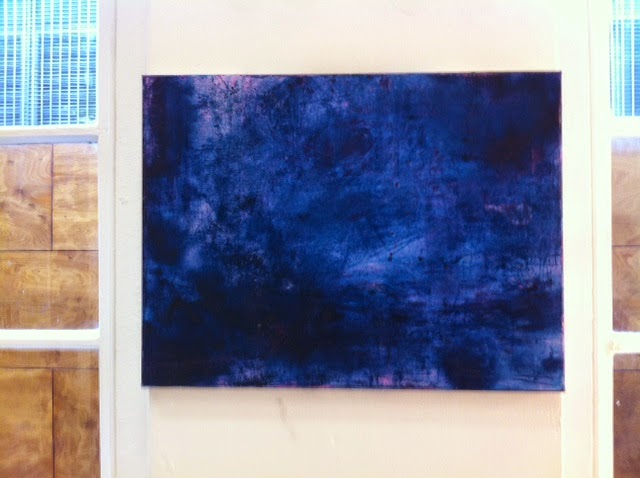


At first I thought I was going to put it in the triangle space but then I tried and felt that my painting was getting lost among the largest pieces so I went back to the smaller Gallery and was looking around for a suitable space till I found one between the windows. I didn’t want to put my painting on the main wall; I wanted to do something different so I decided that it would fit perfectly between the windows and near the two works nearby which were quite colourful but different from mine. There were some interesting dynamics going on while setting up. Some students just wanted to set up with student friends of theirs, others just stuck their work in one place and never moved it, other students were discussing in groups how best show their work and kept changing the position of their work but they couldn’t do it entirely because some other students weren’t part of the game and didn’t want to move their work at all; a lot of students were just territorial and I think it was amazing that we were able to mount an exhibition at all. I was glad I found a spot that suited my painting and went well with the other works around it.


In this specific painting I was inspired by the exhibition by Turner that I saw at Tate Britain,by the way he painted storms, and his use of light. At the same time I was concerned with a much darker tone, in this case blue which cannot be read in one way, I tend to immerse myself in my painting and find dark blue deeply calming. Painting relaxes me as I have high anxiety levels and I find that when I am painting I forget everything. I can go back in time or recreate an alternate space where I can breathe, where I can have space, I don’t feel I have this in my daily life. Each painting I create has its own rhythm, space where I can be but the pink adds a hidden sparkle, maybe what am I saying with the painting is that underneath the darkness and the storm there is a light but the light is hidden - you have to look for it.