Monday, 14 January 2013

Galleria Nazionale D'arte Moderna: Paul Klee in Italy

Paul Klee (1922) photograph by Felix Klee Berna, Centre Paul Klee

I didn't find the exhibition on Paul Klee straight away, to get to the exhibition I had to go through the main collection and there where  many good art works in the main collection that I kept wondering around and got lost till I found myself in a darker room and then I realised that I was in the Paul Klee exhibition section but there where no signs indicating so from the inside of the main collection to the Paul Klee exhibition which I found peculiar & confusing still it was a well curated exhibition that focused on the influence of Paul Klee's six Italian trips and the influence they had on his art work such as the architecture, landscape, music and classicism. The exhibition is divided in sections: the First section I literally stumble into looks at the periods between 1902-1932 so included in his first trips to Rome,Naples, Florence and then Sicily. They also have a section on his relationship with the Bauhaus ( he thought between 1921 & 1930) while he was teaching there and with the futurism.  From the first trip he made satirical zinc etchings named Invenzioni or Inventions with a grotesque classicist inspiration, La Commedia dell' arte, inspired also by Greek mythology and clearly defined is L'eroe con l'ala below, a contemporary Icaro but mutilated who can't fly any more, representing the fragility of modern man. Most of his paintings and drawing that I saw in the exhibition where of a small scale.

Paul Klee The Hero With The Wing


 I think the strongest Italian influence on Paul Klee was the actual Italian landscape, its vibrant colours & architecture as we can see in Croci & Colonne, Crosses and Columns below  a watercolour on paper where there is strong influence of the Byzantine mosaics of Ravenna with a juxtaposition of continually repeated warm and cold colours without any presence of volume so to highlight colour, a dance of colours, inner movement, light more then form while hinting or reviewing french pointillism and using fine lines.

Paul Klee Croci & Colonne 1931
Paul Klee e l'Italia in mostra a Roma


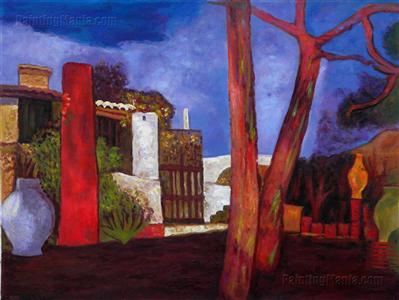
Paul Klee's passion for the Italian landscape is shown again in the piece below; a watercolour of rich vibrant colours of the house where he was staying during his trip in Sicily.

Paul Klee Mazzaro' 1924
Paul Klee e l'Italia in mostra a Roma

Then there is the Nocturnal Festivity, a feast of warm autumnal, earthy colours below. The richness of the oil colours show the painting as highly imaginative with a dream quality to it, they drew me in I kept going back and back to view the painting & I wasn't the only one other viewers where doing the same. I just wanted to be absorbed by the warmth, inner joy they where giving out. The simple way the house had been depicted reminded me of primitive art and the art made by children and again I noticed the importance of nature in Paul Klee's work and it made me think of how I paint my own works and which types of paints I use that it does make a gigantic difference using high quality long lasting paints.

Paul Klee Festa Notturna-Nocturnal festivity 1921

Tuesday, 8 January 2013

Galleria Nazionale D'arte Moderna: Leoncillo Leonardi

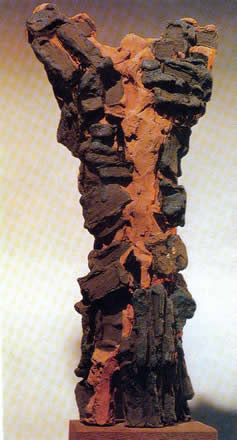
Leonardo Leoncilli

In the Galleria Nazionale D'Arte Moderna there are many rooms filled with real gems from paintings to conceptual works and I was happy to see that they had also included ceramics more specifically the work of the Italian artist Leonardo Leoncilli. I am interested in this particular artist not only because I work in ceramics myself but  for the wider scope and life he gave to a traditional method of working such as ceramics, he pushed it away from decorative  into the conceptual realm.
The work I saw in the Museum it's called: Bombardamento Notturno 1954 translated as Night Bombardment. It is of a large scale (I have never seen an abstract ceramic piece of such large scale before) is one of his best works and was shown at the Venice Biennale in 1954 the interesting part of it is that the artist made this ceramic piece of a mother protecting her child from the bombardments which are a realist image into a powerful abstract which is given by the large scale of the work of contorted clay figures combined with strong enamel colours, a metamorphosis of intertwined colours that expand upwards & around giving a sense of further space to the work. The structure itself with his roughness gives a sense of sheer life, torment and then death but also volume, physicality. He presents something you can not as a viewer simply walk away from both in the way the sculpture is made and in the concept he is presenting this is also due to the large scale and strong colours, you can't avoid it. The ceramic sculpture screams from every pore look at me you can't just walk away from what happened. Another powerful work is: La madre uccisa dai Tedeschi del 1944 translated as The Mother killed by the Germans he gives life to the figure by adding volume to the structure horizontally.

 
His initial works where realistic and had a natural feel to them but then he revolutionised them by deconstructing and breaking them, making them abstract as you can see below in Tempo Ferito II 1962 where the work intertwined there isn't a distinctive main figure.
It would have been interesting to see more of his work in the Galleria D'arte Moderna or indeed abroad I have never seen his work in England. His work made me think about how I make my own ceramics especially the scale of his art work. I could in the future work on a large scale in ceramics but that depends very much on space and in London I find that studio space is very hard to get due to high demand, lack of space and luck of funds so artists who are not wealthy can be limited on what they can produce if they live here and they don't have a specific commission running. This is I would say the negative  side of being an artist in London if one wants to do produce large sculptural or painting work it can be challenging to do, without a support network or basic funds as everything here is so expensive. So I am also working on a conceptual piece and with conceptual I can really use any area at my wish so that I can deal in  a positive way with external limitations while creating new work as it doesn't need a fixed place to be set up and I am not bound by external funds. Yes guerrilla conceptual art for me it's the way forward thought I will still make sculptures in ceramics and other materials.

Sunday, 30 December 2012

Galleria Nazionale D'arte Moderna Rome: Alfredo Pirri-Shay Frisch.


                            Galleria Nazionale D'Arte Moderna www.gnam.beniculturali.it/

While visiting Rome I decided to go and see the Galleria Nazionale D'Arte Moderna I was very surprised by the variety and high quality of contemporary art I saw on show in this gem of a Museum.
First of all if you are a tourist visiting the museum I strongly advise you to take n.3 or n.19 tram which stops in front of the museum as it's not a 15 minute walk to the museum from Piazza del Popolo as some people say when it's dark I wouldn't advise tourists to walk through the park Villa Borghese late in the afternoon in winter, especially if you are going on your own, it's much better in full delight where there other people around in the summer. Also I have read on some websites that the National Gallery of Modern Art doesn't have a cafe', this is actually incorrect. The cafe' is not inside the museum but you have to go out outside and walk to the back of the museum where it is located, beautiful in the summer but not to sure in the winter I guess it's ok.
While entering the building pass security I was transported straight away into a different space. I kind of left the present space I was in and the traffic of Rome and went into an altered space thanks to the work of the Italian artist Alfredo Pirri (born 1957 lives and works in Rome) and his artwork titled Passi (Steps) I literally stepped into the art work as it is made of wide broken glass and I was braking it even further by walking on it so that I could reach on foot the main exhibition area, I was basically forced to do it as there was no other way to reach the exhibition area.                                                

  
Alfredo Pirri, Passi.

I thought this was great fun,  to be able as a visitor to participate in the art work and be able to change the structure of the artwork by walking on it so by breaking even further the glass I was walking on, permanently changing the image of the art work and the vision of it, the image and the memory of it, so that really there is never a final image as the artwork gets constantly cracked by visitors.
As a viewer I didn't see any separation from myself and the art work I did not feel separated as one might look at an image from a still point of view at a distance I also felt unsure walking on it at how much further I was breaking the image and the artwork but excited that with my movement I was producing a further alteration to the art work. The breaking of the glass made met think also at the fragility of life itself and at how things both in real life and in art are constantly changing.
When I reached the main exhibition area I turned and looked back at the art work  & felt like I had just been through some sort of mental portal, this was given by the artist counterpointing the stylish shiny squares of broken glass with stylised white statues, white walls & columns. Because of this I felt like had been enveloped in an ever changing defined altered space. He basically made the best of the space that was already there and the artwork worked really well in this wide important space and it wasn't finished there...
I was initially supposed to see the Paul Klee exhibition but the permanent collection on the ground floor and other floors was so good that I lost track of time so I kept wondering around from room to room and then by mistake I ended up viewing first Shay Frisch's work on the second floor before Paul Klee's work.
                                                   Shay Frisch Peri, Campo 100535 B/N

Shay Frisch Peri is an Israeli artist &  Industrial designer that works and lives in Rome.
He works with light & space. The first work I saw  geometrical in form enclosed in a geometrical white tower inside it was black with an orange bright light going through the work and for me far to claustrophobic but the strong geometrical form and black (darkness) and white (light) both of the outside and on on the inside made me think of a modern version of a church or a chapel so of a spiritual aspect of the art work. I moved quickly to the second room which felt more opened and I was faced by squares of light white adaptors. In this room the art works where made out of the same materials as in the first room. The work it's self is made of endlessly repeated electrical adaptors (the light is shown as volumetric thanks to the actual structure of the adaptors) like some form of light sculpture made out of geometrical forms squared or circles or completely white or completely black with bright orange light beaming from the art work in a linear way which made me think of a minimalist and a precise  controlled way of arranging the work. The light adaptors united together create a new reality, a different way of painting that takes into account architecture, light and space. I found the modern monochrome use of colours (light adaptors) and the juxtaposition of dark and light, spiritual like looking at the Rothko's paintings when I went to the Tate Modern, it was peaceful. The artist didn't force me to participate but to be an observer and to take whatever I wanted to take from the experience. I did wonder thought at how much did it cost to keep the beaming  light on all the time and would the artwork still function if it was made with out the light beaming through it? The answer is no it wouldn't work as the light added volume and changed the meaning of the whole artwork itself. Without the light  it would be like looking at an empty white or black surface even if it was made with adaptors which in itself gave depth to the work.

                                                    Shay Frisch Peri Campo 100535 B/N
                                                    Shay Frisch Peri Campo 10035 B/N

Wednesday, 26 December 2012

Whitechapel Gallery: Maurizio Cattelan

My tutor at University suggested that it would be good for me to view an artist whose work is very different from mine so I decided to go and see the last day of Maurizio Catellan's exhibition at the Whitechapel Gallery. As I entered the gallery I noticed straight away that there was more of an Italian crowd then a British crowd going around the gallery.

 Maurizio Cattelan Il Bel Paese 1995
The first art work I saw was the 'Bel Paese' piece which was composed of a green rug showing the Bel Paese Italy as in the cheese with the same name by Galbani. The opposition of the word Bel Paese=Beautiful Country & the image of Italy on the rug gave clearly out that there is hypocrisy behind the image of the Bel Paese. The funny thing is  that the supposedly 'Beautiful Country' Bel Paese shown as a rug where one can clean one shoes but is not allowed to do so as the rug was cordoned of which made me laugh: a rug which one can not use.. meaning that the rug is still a work of art worth money and worth of cordoning off. I am not sure if this is a mistake of the curator or if the artist intentionally asked for his work to be cordoned off because if this is the case he is actually giving less meaning to the work. By having it cordoned off he is actually showing his work more as a property with value then anything else which weakens the content of the work or creates a distance with the viewer. As  a viewer I was allowed to look at the piece but I felt kept in my place by the way it was displayed as I or indeed other viewers couldn't clean our shoes on the rug if we wanted to. Yes they have put a Roman hand hanging from the sealing above showing the middle finger at the rug but I felt it was better if one could actually clean one shoes on the rug as I think originally intended.
While the piece Lullaby made out of rubble in a large sack, one could touch this piece as I saw a blind man doing so, but would someone who is not Italian know that they are the remains of the PAC in Via Palestro in 1993 where 6 people died due to a bomb by the Mafia? Hiding the rubble in a sack made me think of the hiding of a trauma, feeling uncomfortable with Italy's troubled past.
There are common elements in his work one for example is Maurizio Cattelan's troubled relationship with some of Italy's dark episodes but also showing them to people who might not know about those episodes highlighting injustice and hypocrisy in the system and  in society or in art. The other work I soon noticed called Bidibidobididiboo made out of a red squirrel slumped on a small table with a gun on the floor all in miniature gave me the impression because of the small size of the piece that I was intruding into a story: that of  the artist as a young man stuck in boring daily routine this was given out by the sink and table, I felt that the artist hates ordinary life and has a need to shock to feel alive if not he is like a trapped defenceless red squirrel in an environment which doesn't belong to him kitchen, sink, table are not really a squirrel environment but ordinary symbols of a common life...To me the red squirrel being an outdoor animal represents the wilderness of the artist that wants to get out but gets killed by domesticity hence the squirrel shot in a home environment. Looking at his work it looks not only funny thanks to  the just apposition of opposite elements but well thought out as everything is well positioned, staged and that he likes to get a reaction from the viewer. I mean he used a real cute red squirrel not an ugly wounded  or maybe a fake one which made the viewer (myself in this case) feel sympathy for the cute squirrel/the artist so for the whole piece. 
 I did wonder where the squirrel got sourced from and why did the gallery or the artist didn't care to mention this? Did he found him already dead or was the squirrel killed to appear especially in the exhibition? Just because he is a squirrel and not a human does it mean an artist can do what they like with it? If it was a human someone would make a claim for the body don't animals have any rights because they don't have a voice? I felt this was the strongest piece in the gallery anyhow.
The other piece with absurd upside down elements was the one with artist himself as a still puppet hanging from a metallic hanger closet wearing no shoes which is an out of place image so the intrinsic absurdity if it and the funny element in it. The puppet of the artist is wearing a woollen or felt grey suit which easily gave away the other artist Joseph Beuys. Don't think Cattelan is keen on idealists artist that want to change society or the artist that present himself as the Savior of society as Beuys represents that's why is hanged in a still frame position to make fun out of it as it can't move to reach the ground, doesn't have shoes. Cattelan represent himself in some of his art work with sometimes an ambivalent meaning open to interpretations as there isn't much description about the art work so it leaves it open to interpretation this goes together with other themes across his work such as shock, absurdity, death, authority & humour.
                                                       Maurizio Cattelan Lullaby 1995

Maurizio Cattelan BidibidoBidiDiboo 1996

                                                  Maurizio Cattelan La Rivoluzione Siamo Noi 2000


Thursday, 20 December 2012

New Art from Russia at the Saatchi Gallery

Just before leaving for Italy I managed to get invited for the opening of the exhibition: New Art from Russia at the Saatchi Gallery. The exhibition was well organised I found the members of stuff informative & it was nice to get a free glass of wine while going around the Gallery. I started looking at the work on the ground floor in particular at Janis Avotins in Gallery 5 ghostly, thinly painted canvases using acrylics of mainly female figures that one can hardly see due to the monochrome use of paints which give an evocative feel to the work.The figures are shown isolated & unrecognisable giving them a sense of phantom like air which somehow fit in between being central while melting into the background of the painting. In the same room there is also the work of Nika Neelova which is made of  Burnt and waxed wood, paper and ink positioned opposite Janis Avotins paintings in the main room so one can go around the sculptural installation made out of old beams, casts and worn ropes so shown, re-composed in a different way from their original use. The just apposition of the ghostly paintings on the walls with the burned & waxed wood in the corners of the room worked well as both artists in different ways deal with history. While Janis Avotins deals with history of memory that disappears the figure from the collective memory making it anonymous. Nika Neelova  works with memory history where we get shown how one reads and distorts in the present the past also shown by the ironic title of the art work.  Then I went to Gallery 10 where I saw the work of Valery Koshlyakov: large scale cardboard paintings forming a collage of the the Grand Opera in Paris again we are looking at how things are seen interpreted such as the old empire and at how everything is ephemeral or a mad fantasy depending on once own interpretation as one can seen from the the unfinished details in which the painting is made not showing a final piece of a solid Opera house but more like a fragile imagined castle. I found interesting the contrast between the flimsy support of the cardboard (which replace the solidity of the canvas) with the subject: the actual Opera House which is reminiscent of opulence, solidity, status completely the opposite of the cardboard.  The use of Tempera in making the work and also the Opera House makes one think that the artist as a keen interest in ancient ruins when I was looking at it I thought I might have been looking at ancient ruins or a building in Rome this was given by the energetic brush strokes of the tempera and the passing by of time contrasted by the use of cardboard and a sense of irony towards monumental Government buildings with a reference to the Stalin era.
In Gallery 4 Daniel Bragin is another artist which questions through the use of opposite materials how we view things like in the work Bedtime Story which is made using broken windshield glass and hold together by PVC strings. I found the piece moving and chilling at the same time. As the Bed cover is not made of a nice woolly comfortable blanket but made of windshield broken glass which one would associate with car accidents, violence possibly a lost childhood a dark bedtime story not a light one and then all hold together by coloured PVC plastic threads which  gives  a touch of lightness, innocence to a rather dark fragile story.
                                                    Jana Avotins  Untitled on canvas 2012


                                                    Nika Neelova Scaffolds Today, Monuments Tomorrow 2011


Valery Koshlyakow Grand Opera, 1995


Daniel Bragin Bedtime story 2012


Monday, 26 November 2012

Night Paintings by Paul Benney at Somerset House

Somerset House is an important arts and cultural centre based in central London in the strand overlooking the river Thames. In the winter it contains the ice ring in the summer they have acclaimed concerts exhibitions. They run regularly exhibitions of contemporary art, design and  family events workshops.
                                                                                     Into The Morning, 2008. Oil on Canvas.
Currently in the Underground Burial Chambers of Somerset House also known as the 'Dead House'  which is made out of a series of underground corridors containing in his alcoves the gravestone of seventeen-century nobility (no bodies) and usually not open to the public it runs underneath Somerset House J. Safra Fountain Court.  I saw the  exhibition: Night Paintings by British artist in residence Paul Benney. 


The Burning, 2012.Oil on Wood.
 While exploring the alcoves containing the paintings I did notice two main themes going across his work. Half of his paintings represent nature at night or at sunrise where human figures are absent or playing a minor role in comparison to nature in the painting  giving a sense of feeling of isolation of man as the man is represented as small figure on the right hand side of the painting.While the other half have male figures positioned in the middle of the canvas apparently criminals represented as apostles giving a sense of allegorical meaning to the canvas.. So there is the theme of light versus darkness, most of the paintings the bottom side are in darkness while the light is shined from above on the top half of the canvas. For example we can see this in the painting 'Into the Morning' or in 'View from the Landing' or 'I Came unto Myself. In several of his paintings Also storytelling and the intangible is important and it's given by the titles of the paintings such Levitation, Snow in Jerusalem, I came unto Myself in a Dark Wood etc  but they do describe to the viewer the painting instead of making the viewer guess figure out what is not there. 

All the paintings have been made using oils on wood or canvas or on board some also include resin or encoustic which makes one think that the artist Tome Benney  appreciates, has an interest in traditional methods of making  paintings one can see this in reference to paintings such as 'Burning Moors' which remind me of the vast landscapes of Turner while other paintings made me think of Goya haunted black paintings such as The Colossus and The Incantation, see below. He enjoys working with elements or representing the elements such as water, fire and most of his paintings have been made using muted colours to give a sense of things not defined to give an atmospheric dream like state as one can see from the Painting: Snow in Jerusalem, 2012. Oil on Wood.


Goya, Colossus.


Another of Goya's Haunted paintings; The Incantation.

Friday, 16 November 2012

Pyramids

Lately I have been studying researching ancient Pyramids in Egypt, like many others I have been fascinated with their impressive scale, their hidden meanings the geometry behing them but I am also also looking at how the image of the pyramid is  been used now days in a completly different context by varied artists. I am doing this as in the future I would like to work on a conceptual piece based on the  image of the pyramid but I am also interested in the social meaning more to do with Capitalism that has come up in some Contemporary American artists to challenge the notion of Capitalism as it stands at the moment & their version of producing something alternative to Capitalism: a more equal social structure.
Officially Ancient Pyramids where tombs of the Pharaos and their Queens. But the variety of symbols, their positions made people study & discover other meanings. Some people say they are symbolic of a mountain, that the square base actually rappresents the four corners of the world and four directions and that the peak connects the sky to the earth basically it is a path between the wordly and the heavenly so they where houses of eternity but it also rappresented social class. The social structure was based on power. The Paraoh was at the top with officials then priests then scribes last where the peasants. If One compares this with the contemporary artwork, performance by occupy LA with Robby Herbst where they mirror contemporary class dynamics inspired by a 1911 diagram by industrial workers of the World called Pyramid of the Capitalism system.Robby Herbst & Occupy LA work seems to be about how we act or how we move our bodies to shape the pyramid or reshape and doing so how we shape and reshape our society, our place in the pyramid or how he said it: how we construct and enact the pyramidal form. Or by his other work stacked chairs which I find really freeing, from the obsolate strict hierachy structure of Capitalism which is based on money and power, as anybody can sit on the chairs at any given time


 I am also interested in the Maslow hiererchy of needs, by the American Psychologist Abraham Maslow, which is potrayed in the shape of the pyramid where he says phychological needs have priority over other needs and they should be met first  where self actualization is most important and especially by the fact that he says that without a balance between physical, financial, health, wellbeing, safety maybe  due to war, family violence, abuse people or economic crisis as we are experiencing at the moment a lot of people are at a disadvantage and experience post traumatic stress. So what interest me is not only the physical rappresentation of the pyramid but also the psycholgical, emotional side which in a capitalistic society is taken aside behind producing and consuming. 
There is also the work of David Huffman: Basketball Pyramid  at SF Arts Commission Gallery where he looks at race trought the use of the basketballs, a popular object known to almost any American. Then there is the work of Beau Blinky which is completly different it's more sculputural in a more traditional way on the right hand side he is interested in outdoor sculptures more then indoor conceptual work so another different function of the pyramid.

and then there the minimalist Isometric paintings Pyramid of Sol Let Witt which are directly painted onto a wall as other minimalist artists he was interested in the idea not to show that the artist had created the painting so he left just instructions on how to paint it for others to do it.
 Sample of other art works rappresenting pyramids made from scraps or Lego


Or the human body as the pyramid through it's chakra centres as it's known in new age circles. I have been looking at the different forms and meanings of the pyramid for my own conceptual work I am interested in the actual physical structure, the geometry but also by the different concepts that have been used by contemporary artists that have used the image of the pyramid combined with concepts to open a discussion about Capitalism and our role in society.