Friday, 17 November 2017

My photographs & Dan Rubin's workshop in London.


Photo by Mirta Imperatori
After viewing the exhibition Instant Stories by Wim Wenders, I  joined a photographic workshop run by Dan Rubin - see his Instagram & Twitter accounts for further information on him at the bottom of this page.
As you know, recently I have been going around the urban landscape in London and taking photographs, which I generally do on my own. So I decided to be part of a group for a workshop and to do something different, staying well clear of digital photography for a day, to take photos with a Polaroid. I have never used this type of camera before and I was aware they used to be seen in the past as a fun, playful way of taking photos. Dan told us to roam the streets of Central London and take photos of anything we found interesting, whether people, buildings or whatever. I took photos both in black and white and in colour and like Wim Wenders I was trying to warm up my polaroids, not under my arm pits as this would have proven difficult under layers of clothing but inside my pockets!

Photo by Mirta Imperatori
I wandered around the streets of London with an old fashioned large Polaroid camera around my neck asking strangers to be photographed, a dazzling experience. I got some people who really enjoyed being photographed with an old camera and others who didn't want to be pictured at all (which was actually quite funny in some cases because they were  being filmed by CCTV cameras, at least four of them,  and this would provide much more detail than my old polaroid camera would). This made me ponder about how people are fed up with being filmed and photographed in our digital age, which is fair enough, but we can't escape CCTV cameras in central London now. I used two different types of Polaroids to take the photos in the street. Dan Roubin loved my black and white photographs, particularly one street scene that he said was amazing. He thought this photograph looked like it could have been taken 100 years ago, it doesn't look like central London at all, which is very busy and generally full of people; it's got an air of mystery, see pic. below.

Photo by Mirta Imperatori
He also liked very much my colour photographs done with another Polaroid, which have softer mellow colours. I took photos, portraits of people and strangers in the street, see pic. below, within a given time constraint.
Photo by Mirta ImperatoriAdd caption
I had several people coming up to me asking about my cameras, so the old fashioned cameras prompted a dialogue. I got one guy asking me for my number that made me laugh because it was so not London where people don't usually communicate, they prefer to shut down because it's so busy. And it seemed none of the other members of the group had as many people coming up to them. All our photographs look very different from each other, some took photos of people from a distance, some took close ups, others concentrated on the buildings, the architecture. I enjoyed manually changing films in the street.  It was an enjoyable workshop with a leader in his field.

https://twitter.com/mirtaimperatori?lang=en

https://www.instagram.com/danrubin/?hl=en
https://mobile.twitter.com/danrubin?ref_src=twsrc%5Egoogle%7Ctwcamp%5Eserp%7Ctwgr%5Eauthor

Instant Stories: Wim Wenders' Polaroids - Photographers' Gallery - Recommended.

Wim Wenders - Photographers' Gallery
                   
The long lost art of instant Polaroids. It seems another life as we are now accustomed to the digital fast and furious of the right here right now, the endless photographs on Instagram and other online platforms, of the hyper real, of people projecting their wonderful lifestyles worldwide.
The Wim Wenders exhibition is a visual diary of his trips, a notebook of what he saw, the objects and the people he encountered, the magic of instant Polaroid, of the surprise of not knowing what the camera will dish out each time; of waiting with his photographs under his armpits, to make them warm up and developing them correctly while doing other things; the magic of having an original, different photographs from all the others;  the magic of telling one's own story, sharing the experience with each instant Polaroid picture. I have to say this exhibition was a delight, not only because it includes some 200 photographs by Wim Wenders (he took thousands), but also because it is a very well curated exhibition. The photographs are neatly framed together, with a tight frame that only shows the centre of the photograph, at its best. On the day I went the exhibition was very busy; I also saw the actor Jude Law wandering around inside the gallery. So I was glad to have turned up early for it as I could spend more time looking at the images. As they are positioned closely together and being fairly small, as you would expect, they force you to look in, they have a natural, nostalgic feel to them that you can only get with this type of camera.


Wim Wenders - Photographers' Gallery
There are Polaroids of his trips across the USA and Europe, of famous people such as Dennis Hopper, of friends,  of strangers, of daily life, everyday objects he would encounter in drive-ins and other places such as rooftops, cars, shop fronts. He builds a visual story, a way of remembering places, faces, and moods. Also showing are excerpts from his film, Alice in the Cities.  Another of his films, American Friend, has Dennis Hopper obsessively taking photographs of himself, this too is showing see pic. below. Wim Wenders said he took about 12000 photographs while he was filming between 1973 and 1983 but that only 3.500 of those photographs remain. He said he took pictures of a person and sometimes he gave the photographs to him or her.

Dennis Hopper as Tom Ripley in American friend by Wim Wenders
                               
Wim Wenders himself was also obsessively taking photographs of what was around him at the time. The Polaroids in the exhibition have been grouped under titles such California Dreaming, Photo Booths, Mean Streets, Typewriters, Looking for America. All together they create a visual diary of a bygone era. The Polaroids are instinctive. Wenders also said he has not taken any Polaroids in 30 years, he is now 72 years old and he had first learnt to use a camera as a child, taught by his father.  He says he never saw himself as a photographer. Part of the charm of the Polaroids in this exhibitions is that  some of them are badly over or under exposed, they create a specific mood, they have an air of mystery to them, they are romantic, they point at something lost, that we no longer have, a gone moment in time that we can only retrace through the photographs themselves. This is the complete opposite of taking photographs with a digital camera, or an iPhone, where the photos are pixels, or on Instagram where we are constantly looking at hyper real photos. Like Wenders says, photography has changed for him; the act of looking nowadays doesn't hold the same meaning - he said in an interview that nowadays it is about showing, sending and maybe remembering. While to me, in this exhibition, those Polaroids are all about remembering.

Dennis Hopper photo by Wim Wenders - Photographers' Gallery

Wim Wenders & his daughter - Pinterest
The Polaroids are a storybook, his stories, his encounters with people famous and non famous, for example with a young Annie Leibovitz who takes him on a trip to Los Angeles. There are Polaroids of her driving. Or of hearing about John Lennon's death while driving in LA. In the exhibition there are  also several portraits; Polaroids were frequently used for taking portraits; my favourites are the ones of Dennis Hopper who was actually a photographer himself. The Polaroids of him do go well with the film of him taking loads of pictures of himself in manic fashion, he definitely predated the obsessive selfie culture we now have. This particular set of photographs is a take on the obsessive nature of self and fame and of how really it is all redundant, because by taking so many photographs of himself in the film, not only is he showing his sociopathic, manic tendencies but he makes the act of taking photos redundant and it turns the viewer into a voyeur. Brilliant exhibition.

Tuesday, 31 October 2017

Sheila Hicks: Stones of Peace - Alison Jacques Gallery.


                                           Sheila Hicks - Photo Alison Jacques Gallery

On a bright sunny day I viewed the exhibition by Sheila Hicks at the Alison Jacques Gallery, entitled Stones of Peace. This includes a variety of her works, with large sculptural pieces that go beyond textile to inhabit the installation realm. They are imposing, soft, colourful sculptures that hang down from the ceiling, resembling loose ponytails, see pic. below - if you touch them they move. There is movement in this specific type of work, unlike her minimalist work on the walls, they change every time they are installed in a new exhibition space. Opposite on the floor are large balls of colourful intertwined yarns, more of a rough nature, made with synthetic yarns. Some of her work is made with handlooms. 

                                             Sheila Hicks - Photo Alison Jacques Gallery

On the walls of the gallery are her minimalist works; they are white and go towards paintings, they are more controlled due to being just one colour and wrapped on hard material, all of them are made with soft textile materials, some natural, some synthetic and what joins them together is the repetition of wrapping the material; it’s a very meditative way of working, spending time intertwining and wrapping see pic. below.

                                           Sheila Hicks - Photo Alison Jacques Gallery

In the more colourful works there is playfulness, while in the white minimalist works there is instead calmness, a stillness. The soft materials and the way in which they are shown in the gallery make you want to touch them, they are tactile, large and small but when they are intertwined with each other as in the balls on the floor they gain in volume, because they are also amassed together in a way you would want to sit on them and play with them. This is also due to the bright colours they are made of and the soft texture. I really felt the urge to pounce on them, but I refrained as I was aware I was not allowed; it would be great if they actually allowed people to jump on them and play with them, take the whole thing further, fill the whole room with them and allow people to just have fun, they tried this in another exhibition. At the moment you can look but you can’t touch or play with them so they sit in between, a sculpture, installation and textile, see pic. below. 

                                          Sheila Hicks - Photo Alison Jacques Gallery

The way she threads them also makes you reconsider what textile in the past was used for, but she shows the unlimited potential of the material, taking it into a new realm altogether, moving textile forward into new directions.
In the second room are her ‘Minimes’, small weavings which are made with a hand loom, which she has been doing for the past 50 years. They are intimate pieces with feathers, porcupine needles, shells, paper, or bamboo or even steel fibres, sensitively added on to the piece and not overpowering the work but complementing it. Some are more brown in tone than her other more colourful works in the main room. Due to the small scale of these works, they draw you in like you would find looking at miniature work, so you have to go close up to them to get a proper feel for them. Some say it reminds them of the paintings of Italian artist Giorgio Morandi, see pic. below. 

                                            Sheila Hicks - Photo Alison Jacques Gallery

Some of her initial work was based on pre Columbian weaving structures while from 2005 she started using synthetic filaments, which the balls also called boules are made of. All the work in this exhibition was presented indoors; I think next time I would love to see her outdoor works.
Sheila Hicks in an interview with Arnet Magazine said: Textile had been relegated to a secondary role in our society, to a material that was considered either functional or decorative.  I wanted to give it another status and show what an artist can do with these incredible materials.
This was a very enjoyable and stimulating exhibition.
Hicks has a BFA and MFA from Yale University and studied under Joseph Albers, and Eva Hesse was a fellow student.


Sunday, 15 October 2017

Hamiltons Gallery Photographic Exhibition by Christopher Thomas.

I thought it was a normal day like any other but it wasn't to be. Inside the underground I was calmly walking behind a guy with a trolley suitcase when suddenly I saw a guy on my right, very tall 6 feet tall, rushing past me and bumping into the trolley suitcase in front of me; he fell forward really badly, hitting the ground literally in front of me and gashing his nose, I went up to him and asked him if he was ok. He nodded angrily at me that he was ok. Several other people rushed towards him. I decided to quickly move on as there was no way I could help the guy any further, by helping him to get up as he was so big & tall, so I let the other people around me help him up. I have often seen inside the underground people having accidents because they are not paying attention, when they are in a rush, or tired from long hours of commuting and work; sometimes they push others to get through. When I am on the escalators I always stand well away from tourists with large suitcases. I have seen time and time again people carrying huge suitcases and not managing them properly on the escalators, blocking others & accidentally falling forward basically causing accidents. I have also seen people running down the escalators not holding to the handrails and I am thinking jeez if for whatever reason the escalator stops they would fall forward and take others with them, and hurt themselves really badly. I have seen it happening, the injuries weren't a joke, a whole pile up of injured bodies down the escalators, luckily this doesn't happen often. But some  people still run down the escalators, and we are supposed to be the 'intelligent, advanced species on earth'! But we struggle with making even the most simple changes in our behaviour; in our routines we hold on to the same behaviour. So I still see people pushing and shoving others to get forward to get to the tube, as though their life depends on it. But the trains come nearly every minute! I finally got out of the underground and everything was fine.

Photo by Christopher Thomas - Hamiltons Gallery
I went to Hamiltons Gallery in Mayfair to see the photographic exhibition by German photographer Christopher Thomas (his background is in advertising) titled Lost in LA. While I was in the gallery I was greeted by Tim Jefferies the owner who was very friendly. He has a long history of  showcasing photography in the gallery. The photographs are made with a Polaroid film type 55 ( there is at the moment a revival of this and other Polaroid formats) and then digitally scanned so it's a mix of the two processes. The fact that they are taken with a large Polaroid with long exposure in black and white gives them a nostalgic, ethereal feel, they are photographs of classic buildings taken in LA, such as the Hollywood signs, and McDonald's, see pics. above & below.

Photo By Christopher Thomas - Hamiltons Gallery
They show no humans or cars, but empty vacant spaces; quite the opposite of what we associate with LA which is busy and polluted; this is a rare thing, a dream. There are also photographs of solitary piers and oil pumps.

Photo by Christopher Thomas - Hamiltons Gallery
Christopher Thomas took the photographs over a period of three years while staying in a camper van; the photographs are carefully planned so as to keep them free of people; he would need to take them very early in the morning or late in the evening.  They are not conceptual photographs but they are his own portraits of the city, its structure, a peaceful view of a bygone era. The dim lighting in the gallery added to the nostalgic feeling of the exhibition. The quiet ambiance of the gallery suites the exhibition well.

Sunday, 8 October 2017

The Natural History Museum Kensington Incident & Wade Guyton at the Serpentine Galleries.

Life in London is becoming more and more crazy, between terrorist attacks & weird incidents like the one I experienced this Saturday opposite the Natural History Museum in Kensington.
I had just come out of Kensington Station & I was walking up the main road when I got to the intersection where the Natural History Museum is and there was a pile of cars on the main road. At first I thought it was a robbery, one black car had crashed into a grey car and was facing the pavement with the driver trying to escape. I saw him being held down on the ground by three security guards, there was blood coming out of his nose, they were waiting for the police to arrive, I saw a pair of shoes behind him and the door of the black car wide open which made me think that he had tried to escape before he got caught. The official story in the papers yesterday from the Government was that this was a traffic accident. I am sorry but in traffic accidents you don't get people mown down by a car, nor do you get a guy being forcibly held down by security people, see the pic I took. 

                                                        Photo Copyright Mirta Imperatori

I saw a woman lying down on the floor next to the Museum helped by several people, she looked shocked. Then I read in the papers that 11 people were injured by a car. There is more to this story than meets the eye.  See how it has been reported in the media.
http://news.sky.com/story/kensington-crash-witnesses-tell-of-mass-panic-11071245
https://www.standard.co.uk/news/london/south-kensington-police-descend-on-area-outside-natural-history-museum-after-car-hits-pedestrians-a3652986.html
I quickly walked away from the scene because I could hear the police descending upon us so I decided to make a quick exit out of there before the whole area was put in lock down. I was just thinking that I had two near death experiences in the last couple of weeks. Just a couple of weeks ago I was walking on a road, I passed a rather large tree literally on my left hand side when suddenly I heard a huge thud behind me; I turned around and saw that the whole tree I just passed had come down and had crashed on top of a car that was parked there, causing considerable damage. It just missed me! 
Anyway I helped a Chinese couple redirecting them, I told them not to go where the incident had just happened, that the police were in the process of sealing off the area, I told them to go to High Street Kensington instead, they thanked me for my help and quickly moved on. So after all of this had happened I was really hoping to see a good exhibition at the Serpentine Galleries. Sadly this was not to be the case. 

                                                      Photo by Serpentine Gallery

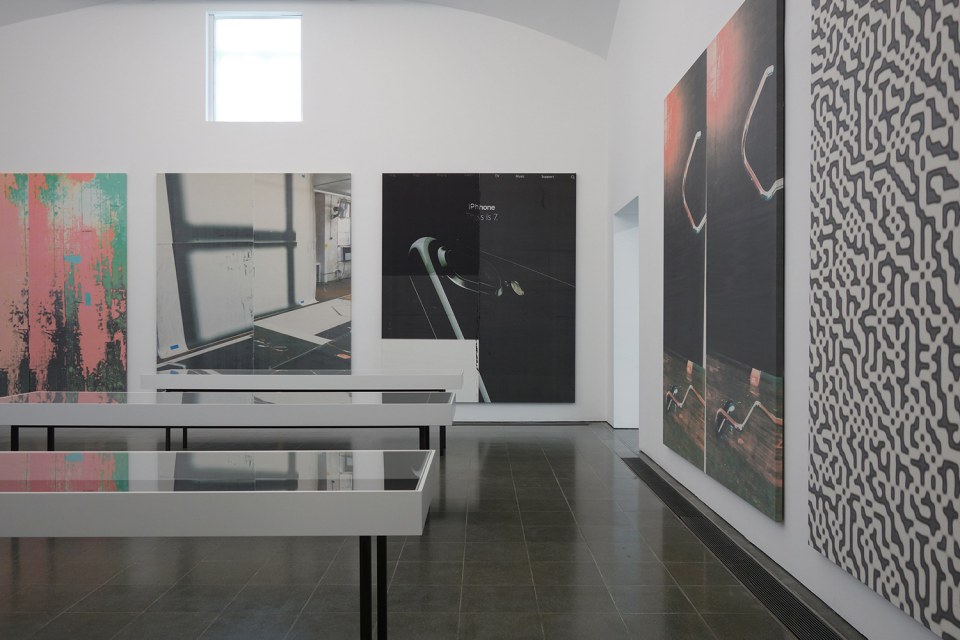
The exhibition was of Wade Guyton see pic above and below.  His works are made using IPhones, cameras, and an inkjet printer. All the images were printed on canvas on linen, some images were blurred, he says they are a record of their own making. Yeah right, he is making them just using a machine, nothing new here. In the brochure it says that he analyses our relationship with digital media. I found the work in the exhibition outdated, not current, and a tautological exercise in blandness, the Gallery photographs of the exhibit actually look better than the originals. The original images don't give you anything back, just  accidental flatness.

                                                       Photo by Serpentine Gallery

This type of art is for corporates that want to buy this type of work to offset their taxes because there is really nothing else to the work, not the ones I have seen at the Serpentine Galleries on this occasion. What! You take pictures from your Iphone or inkjet printer, not even well taken and you just put them on a canvas.... how ground breaking! I mean there are loads of people online that do this and do it better, their work may not be bought by the big guns in the art world because maybe they don't know how to promote themselves, sell themselves with a clear package but that doesn't make it any less valuable. I have seen much better stuff inside Universities in the UK, more up to date with what is going on in digital media than this exhibition. The only interesting piece I found in this exhibition was of several canvases stacked together, the front was different from the sides, so it turned itself into a sculptural piece, most of the canvases were of  a standard size or large. There were also tables with more images inside printed on paper not on linen like the canvases, I find this pretentious, the images were of really poor quality, he could have left them out; by putting them inside the table as they are small and not of good quality it just didn't make me want to look at them. Why  would I want to look at something of poor quality inside a see through white table on poor quality paper at a lower level? The tables were smart tables like you see in pretentious establishments for wealthy people, bizarre! I find the concept of  this work poor. They call it conceptual paintings and that he goes against painting. He works with the machine but don't be fooled, he is no Gerhard Richter.  I have seen better work done online by strangers! It made me ponder the fact that if you finally get picked up by a big gallery you can really sell anything and pass it for innovative and then get more people to buy your work no matter what nonsense you give them - they will buy it because the big gallery has taken the work and given it value.. finally I just want to say that if a woman did this same work she would not be taken by the gallery.
I wasn't in a good mood when I came out of this exhibition. 

Tuesday, 26 September 2017

Living Cities Exhibition - Tate Modern: Ai Weiwei, Stephen Shore, Birdhead.

It's often better not to react emotionally to a situation but stand back and think before one acts rather than react impulsively. There are men in power who react like a child who has not mastered control of his emotions. The only thing for sure that happens when this type of personality gets in power is conflict, the only way they can truly be and feel is through creating antagonism, division and utter chaos. I was just thinking this when I read the world news. I strolled to the Tate to have a coffee and see the exhibition about Living Cities on level 4 of the new building at Tate Modern. Wouldn't it be great if such men could engage in art, the environment, helping others make the world a better place instead of handling their egotism and rage into creating more conflict and misery.

                                                               Photo Tate Modern

The exhibition shows a selection of artists from around the world and how they experience living in the city. It's a reflection on how the city can be a utopian place involving communal living, or a place of protest. Ai Weiwei has been a positive example of how an artist can create wealth for others through his work by creating  a studio where assistants worked on his projects in the city he lived in, Beijing. The studio space was an oasis but now he is living in Berlin as a refugee (but this was not mentioned in the video shown at the Tate which is basically now outdated, see link below).

http://www.tate.org.uk/context-comment/video/ai-weiwei-on-beijing-artist-cities

In the show there is a video of him in his former city Beijing. At one point they are shown putting red lanterns around surveillance cameras in the street outside of his studio. Ai Weiwei says it to high-light them, to make it more clear that you are  under constant surveillance, that there is no freedom of speech. In the video the buzzing of a busy city, Beijing, is contrasted by a tour of his studio where they are seen working on a project involving surveillance cameras made out of marble and we see the courtyard that looks like an oasis of peace. The neighbourhood around is oblivious to what goes on inside of the studio space. He called his studio 'a station from outer space'; it's shut in, behind a metal gate, an art city within the neighbourhood  of Caochangdi the 5th ring of Beijing and he has created a similar environment in his current home of Berlin.

                                                               Photo Tate Modern

Another piece that interested me in the exhibition is the photography by American Photographer Stephen Shore, as I also take photographs of the ordinary and every day life. His photographs consist of his travels in different American cities in 1972, 1973. He photographs the ordinary, the every day in life. The photographs are displayed closely together and framed, this requires your attention as a viewer, it forces you to go close up to them to be able to see them properly, individually and not as a whole. They are photographs of ordinary people, walking by in their daily lives. He travelled across the USA, discovering Middle America as he had been mainly based in New York. His photographs are intuitive and they are to do with light and colour. He is a pioneer in colour photography see pics below, he also photographs the overlooked. They include street photographs, motels, basically what is right under our eye but that we do not see. The every day in his colour photography was not appreciated in the 1970's but his photographs became more appreciated later on. To be noted is that he used a view camera for documentary photography which was unusual. 


                                            Copyright Stephen Shore taken from Pinterest

Opposite his work are the photographs by Birdhead which is made out by Ji Weiju and Song Tong who work together and take photos of the every day in Shanghai. Their photographs are very different from Stephen Shore's, first of all they are monochrome and printed in large format on paper and hung not framed. There is no narrative in their photos but the subject of the photos creates their own narrative; like Shore they photograph people going about their daily life, the every day: potted plants, vegetation, tree trunks next to architectural subjects such as bridges, new apartments in Shanghai. They wander off and destroy the film after printing so it becomes a limited edition.
They use an analogue camera, the subject matter of a young person's Shanghai, directed by their own formative experience.
If you are a Gallery or a Magazine and you are interested in my work contact me here:
https://twitter.com/mirtaimperatori


Wednesday, 20 September 2017

The Parsons Green Bomb in London & Fahrelnissa Zeid 's Exhibition at Tate Modern.

I am trying to keep some sort of normality in a period which is not really normal, the day after the Parsons Green bomb I went to the Tate to discover level 4 of the new building. I asked a friend if she wanted to come and she told me she was too scared because of the bomb at Parsons Green. Another friend said the same, they didn't move from their areas. So I went on my own, because maintaing a normal way of living for me is the only way forward and I don't let such events put me off, I think one is still more likely to be run over by a car rather than anything else. We still have more people dying of depression and suicide due to the poor level of access one gets for mental health in this country. But yes, it wasn't a normal day with the anti terror police visibly deployed across London and on the tube the driver was shouting down through the intercom system at each stop: 'If you see anything suspicious contact the police' and gave the number. I was thinking that by the end of his run the driver would be voiceless. Myself and the people opposite each other were just staring at each other like lemons, hoping that it wouldn't happen, literally to be in the same compartment or in the tube with a bomb. I think the people on the Parsons Green train have been incredibly lucky because the bomb didn't detonate properly. It will take time for them to recover because burn wounds even if small are very painful. I wish them a speedy recovery but it will take time. I remember I went to a talk by a survivor of one of the earlier London bombings. I was really impressed by him and his own experience of the event and how it had affected him. I will never forget it. I was happy to see security at the Tate, checking bags equipped with a metal detector, they were everywhere. But it made me realise that we are rally going through a mad chaotic period, and it is important to stay calm and to keep going. It can actually make you more focused and present if you don't give into fear. Anyway it was great to see London busy as usual, people walking around like normal. It was the first time I momentarily enjoyed it as generally you won't see me in a busy place with lots of people. So I got to the Tate, no problems, I had a nice lunch and luckily this time I didn't get stuck in one of the lifts, and it wasn't busy. I saw the exhibition by Fahrelniss Zeid, the Turkish princess artist. She was married to Prince Zeid al Hussein of Hashemite Royal Family who were assassinated in a military coup in Iraq. She was educated both in Paris and Istanbul and was part of the Turkish avant guard of the 1940's. She was one of the first women to be taught as an artist in Istanbul.


All the paintings in the exhibition were large and made of vibrant colours, interlocked with each other, but not in a static way.  There is movement in her pure abstract works, see pics above and below, taken from Tate online. In the first room there were also her portraits, which were made in a more realistic style and were very different from her abstract work. Her portraits usually covered family and friends. In the second room, I saw her abstract paintings made of intertwined black and white lines and yellow and red lines as found in islamic Byzantine art or mosaics see pic above from Tate online. In the third room I saw her sculptural work. I find this particular work fascinating with the combination of completely unrelated elements - she was painting on turkey and chicken bones which at a later stage she cast in polyester resin. She also used to paint on stone. In her final years she turned her home into a formal art school.
Coming back from the exhibition, heading towards my friends' area, the journey was chaotic. Inside the train there was a fight between a group of drunken men. The train suddenly stopped, not moving at all so we were all thinking oh dear it's engineering works, leaves on the tracks, a body on the tracks..
Instead the conductor shouts down the speaker: apologies for the delay: we are waiting for the police to take away a group in first class?! Generally in first class there is hardly anybody, I mean you might see one person in the whole compartment nobody wants to pay extra for the privilege apart from a few wealthy people using it regularly. Suddenly the train started moving again  and we didn't see any police coming  on but we soon realised that all is not ok as a bunch of aggressive men shouting at each other walk through our compartment and stop near the main toilet and their shouting grows louder. Luckily I am sitting next to a nice, fit stranger, a guy who is looking out for me and he says: 'are you ok?' I reply 'yes I am thanks for asking'. He says: 'they are making a lot of noise at the back glad we got headphones to listen to music' which in a way made me laugh. They were having a fight at the back while we were listening to music trying to ignore them. What a trip!